

Product database
Abrasion resistance (EN 13888)
The EN 13888 classification A for tile grouts means that the product has high abrasion resistance in its class. Abrasion resistance is below the test limit of 1000 mm³.
Additional features of taps
Additional features specified by the tap manufacturer that describe the various properties of the tap.
Additional options for backing material
The product can also be customized with an alternative backing material. The minimum order quantity is specific to the product. Ask the seller for the price.
| Additional backing material options: | Explanation: |
| CQuestBioX | biocomposite backing of Interface textile tiles, which contains a high amount of bio-based raw material. |
| CQuestBio SONE | Polyester felt backing of Interface textile tile that improves acoustics and ergonomics. Made from 98% recycled material. |
| CQuestBio SONE+ | Polyester felt backing of Interface textile tile that improves acoustics and ergonomics. Made from 98% recycled material. |
Adhesion
Within the EN 12004 standard for fixing mortars, the product composition (C, D or R) is followed by a numerical value of 1 or 2, which describes the adhesion properties of the product:
1 = normal adhesion (C1, D1, R1)
2 = improved adhesion (C2, D2, R2)
For example, a cement-based fixing mortar of class C1 must have a tensile adhesion strength of at least 0.5 N/mm2 and a mortar of class C2 must have a tensile adhesion strength of at least 1.0 N/mm2.
Adjustable seat height
The information about adjustable seat height tells you whether the seat height of the toilet is adjustable. For example, in wall-mounted toilet elements, the seat height can be adjusted during installation using the adjustment feet at the bottom of the element.
Wall-mounted toilet installation dimensions
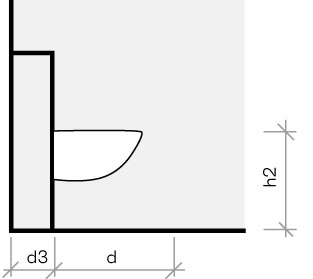
The wall-mounted toilet allows for various installation heights suitable for different user groups (h2):
- 480-500 mm: Wheelchair users, individuals with stiff knees or hips.
- 400/420 mm: Adults and school-aged children.
- 300 mm: Individuals of short stature and preschool-aged children.
- 460 mm: Elderly (or 400 mm + a raised seat).
Depth of toilet (d): 490-700 mm.
Toilet tank and installation frame (d3): 150-250 mm.
Allergy label
The Allergy Label indicates, in an impartial manner, that the product or service meets allergy criteria. The label is granted by the Allergy, Skin and Asthma Federation.
Anti-fog
The mirror has anti-fogging with a heating element.
Application range max mm
The product's application range max mm value indicates the thickest layer thickness of casting compounds and screeds at which the product is recommended to be used. The thickest layer thickness is related to the coarseness of the product's aggregate and the composition of the product. In layers thicker than recommended, the product may no longer function as desired or, for example, cracks may develop.
The application range max mm value generally describes the thickest layer thickness over a larger surface area or applied all over in one application. Depending on the product and case, the layer thickness may be greater than this value if it is a small-scale patch repair. In thicker layers, it may be possible to apply the product in more layers, so that the previous layer has time to harden sufficiently in between.
Application range min mm
The product's application range min mm value indicates the thinnest layer thickness of casting compounds and screeds at which the product is recommended to be used. The thinnest layer thickness is related to the coarseness of the product's aggregate and the composition of the product. In layers thinner than recommended, the product may no longer function as desired or achieve the specified strength values.
Availability
Central warehouse product - the product is part of the stock selection and is stored at the Laattapiste-Pukkila central warehouse in Vantaa. For quantities larger than average demand, it is advisable to anticipate longer delivery times.
Factory order product - the product is part of the factory order selection and is ordered only upon customer request from the factory's warehouse to the Laattapiste-Pukkila central warehouse or directly to the customer. Delivery times vary by product depending on the factory's stock situation. The product may be temporarily available at the central warehouse, but the central warehouse is not replenished for this product once the stock is depleted.
Outlet product - the product is being discontinued and the central warehouse will not be restocked once the current inventory is depleted. The 'end of stock' label indicates that the product is no longer being manufactured at the factory.
Not active - the product is not part of the Laattapiste-Pukkila selection or its production has ended and the product is no longer available.
Backing material
|
Base
There are many types of substrates and it is product-specific which substrates a product is generally recommended for. Substrates differ from each other based on their material properties, such as strength, water absorption, stiffness and stability.
The substrate often has a significant impact on the product used and the overall solution, which is why attention should be paid to the matter.
Bathtub installation
Recommended installation method for the bathtub. In some models, other installation methods can be used, but in that case, the shape of the bathtub and the available panels should be taken into account.
Space requirements for the bathtub
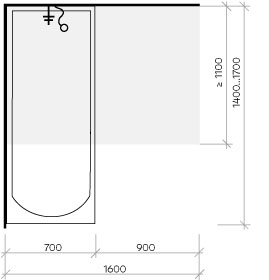
- It is recommended to allocate an area of 900 x 1,100 mm for drying next to the shower and bathtub.
- Storage space for cleaning agents and accessories is needed next to the shower and bathtub.
Built-in element
Indicative description of the wall-mounted toilet element model.
The elements are divided into four groups:
1. High
2. Low
3. Corner installation
4. Slim
Calculating carpet requirements for room orders
Installing wall-to-wall carpet generates a considerable amount of installation waste, typically 10–15%. However, for room-specific orders the waste may be significantly higher depending on the room’s size and shape.
Wall-to-wall carpet is always delivered as a full-width (4 m) roll. Only the length is cut at the factory before delivery.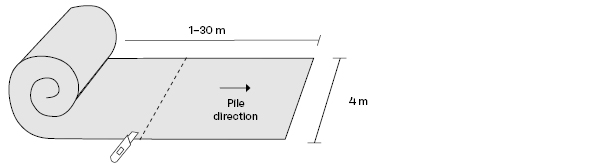
When calculating the required carpet amount, the room’s size and shape must be considered. A minimum of 10 cm installation allowance should be added on each side, as walls may not be perfectly straight.
If multiple carpet widths are installed in the same room, the carpet pieces must always be laid in the same direction. It is also recommended to align the seams and pile direction with the main source of incoming light, meaning towards the window. If the seams run perpendicular to the primary light direction, the seams between carpet widths will be more visible. Please also note that the carpet’s thickness may affect door clearance.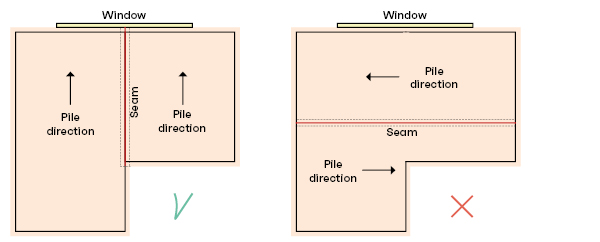
Here are examples of carpet sizing in different types of rooms. Depending on the room layout, a significant amount of waste may occur. In some cases, a missing piece may be cut from the waste material, provided the pile direction matches. It is also important to ensure that any possible seam does not fall directly in a walkway, such as at a doorway.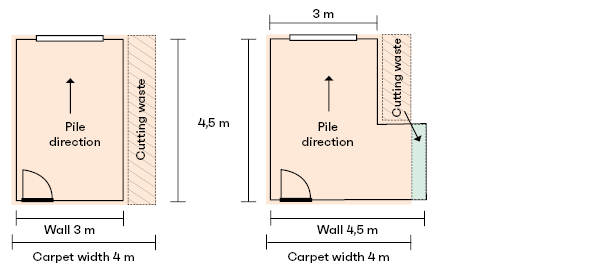
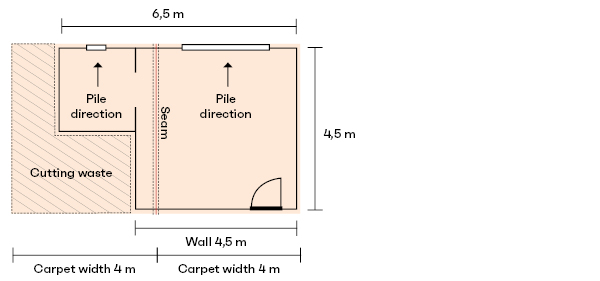
Please also carefully review each product’s own installation instructions. For wall-to-wall carpet installation, we recommend using a professional installer.
Carbon footprint - raw materials and production (A1-A3)
The product's carbon footprint according to the EPD environmental declaration in life cycle stages A1-A3: raw materials, transport of raw materials to the factory and manufacturing.
Carbon negative product
The carbon negativity of a product means:
the carbon footprint in the EPD environmental declaration is inherently negative in certain stages of the life cycle, meaning that no compensation has been used
OR
overcompensation of the carbon footprint has been implemented, i.e. more than the carbon footprint in certain stages of the EPD environmental declaration has been compensated.

Carbon-neutral product
The carbon neutrality of the product means:
The carbon footprint is naturally zero at certain stages of the life cycle in the EPD (Environmental Product Declaration), meaning no compensations have been used.
OR
The carbon footprint has been compensated, meaning the carbon footprint has been offset by an equivalent amount to the carbon footprint at certain stages of the life cycle in the EPD (Environmental Product Declaration).

Castor chair rating (EN 985)
When selecting a textile or woven vinyl floor for a space where office chairs with casters are used, it is important to ensure that the product meets the abrasion resistance class for office chair casters (EN 985). If office chairs have casters, the floor surface will experience particularly high wear in the areas where the chairs are used. Only flooring materials that pass the demanding abrasion resistance test are granted a continuous use classification.
>2,4 Continuous use (public space, e.g., office)
<2,4 Occasional use (home)
Color variation V1-V4
The appearance of the tiled surface is created by the overall look of several individual tiles. The shades of some individual tiles may vary slightly or dramatically in terms of color, texture (such as surface patterns), and other details. Thus, the finished tiling can range from solid colors to multicolored, regardless of the appearance of an individual tile, depending on the product’s V rating. Therefore, a single sample tile or panel is not a representative of the completed tiling.
Regardless of the V rating, tiles should be taken from multiple boxes simultaneously during installation, and a layout plan — also known as a dry layout — should be prepared in advance. This involves laying the tiles to the desired tile surface before final installation. During tiling, tiles from different boxes should be mixed to avoid noticeably different shade areas in the finished surface.
The color variation of the finished surface is described by the V-rating as follows:
| Value | Value description | |
| V1 Uniform | Each tile is made from the same pattern. Color variations are minimal. Tiles can be selected based on a single tile from the same production batch. Normal installation. |  |
| V2 Minimal | There are slight variations in the color of individual tiles. Selection should be made based on multiple tiles from the same production batch. Tiles should be taken from several packages during installation to achieve the desired tiled surface. | 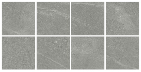 |
| V3 Moderate | The color of a single tile is indicative when compared to other tiles from the same production batch. The color or shade of an individual tile may vary significantly. For example, a small color area on one tile may be the main color on another tile. We recommend that selection be made based on multiple tiles. Tiles should be taken from several packages during the installation process to achieve the desired tiled surface. The final tile surface will consist of several tiles with varying shades, creating the desired effect. | 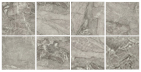 |
| V4 Dramatic | Individual tiles may contain extreme shade variations and a very wide range of colors. One tile may have colors that are completely absent from another tile. Since tiles may have color variations that cannot be seen from just one tile, it is essential to select the product based on a collection of multiple tiles. Tiles should be taken from several packages during the installation process to achieve the desired tiled surface. The final tile surface is unique and one-of-a-kind. | 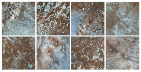 |
Composition
Within the standard for fixing mortars EN 12004, products are classified based on their composition:
C = Cement-based products
The dry mix is mixed with water or another liquid in the correct proportion before use. Hardening/drying is based on the reaction between cement and water and the evaporation of water.
D = Dispersion products
The products are ready-to-use mixtures and hardening/drying is based on the evaporation of water.
R = Reaction resin products
The products are basically 2-component (component A and B) and hardening/drying is based on the chemical reaction between the components.
The composition of the fixing agent creates the starting point for the use, functionality and various product properties of the products.
Consumption in washing after grouting l/m2
The estimated consumption of the product for cleaning grout residue from the tiled surface after grouting. The consumption is approximate and may be higher or lower depending on factors such as the number of joints and the smoothness/roughness of the surface.
Includes a quick menu.
Consumption per unit
The calculated consumption (consumption) of a product in a typical application.
The calculated consumption is a numerical value, usually based on the volumetric weight of the product, and is used as a guide in quantity calculations. The calculated technical consumption does not take into account the variable factors of an individual job site or the possible percentage of waste.
Consumption unit
A unit of the numerical sales value of a product.
Dimensional accuracy
Dimensional accuracy indicates how precise the stated nominal size and manufacturing size of the product can actually be.Dimensional accuracy refers to the verification process of the manufacturing size related to the production standard of ceramic tiles. Depending on the manufacturing method, there may be differences between the nominal size and the actual size of the tile, and this should be taken into account during installation.
| Value | Value description |
| Caliber-classified | The tiles from the production batch are sorted into several caliber or size categories (e.g., A, B, and C), packed into separate packages according to their category (e.g., A-package and B-package), and the size of the tile is indicated in the chart on the package. The tiles installed on the same surface should be either of the same caliber category (e.g., all caliber B) or a smaller caliber category (e.g., caliber B and A). The actual size of the tile is determined by the caliber delivered. The caliber category cannot be selected at the time of purchase, but all products delivered in the same shipment will always be of the same caliber. |
| Monocaliber | The tile is manufactured to one size. Monocaliber tiles are not classified by size, as is done in caliber classification. The dimensions of different tile batches may vary within the allowed tolerance range (e.g., for 20x40 tiles, the tolerance is +/- 2 mm). |
| Rectified | The tiles are rectified by edge grinding after firing to a very precise size category, as indicated in the chart on the package. For example, if the tile size is 30x60 cm, the rectified manufacturing size might be 297x597 mm. When the tile is rectified, the tiling can be done with a narrower grout line than usual, but it should be at least 2 mm. |
| Cut | The tile is manufactured by cutting from a larger tile. The products typically have size variations, and some edges of the tiles may differ when closely inspected and may not be completely faultfless. Individual tiles may have edges that look different.. |
| Milled | The purpose of milling is to create a rustic or antique appearance for the tile. The tiles are rotated in a large drum cylinder with sand, metal balls, and water. During milling, small chips break off from the tile, causing variations in the dimensions and shapes of the final tiles. |
Dispenser type
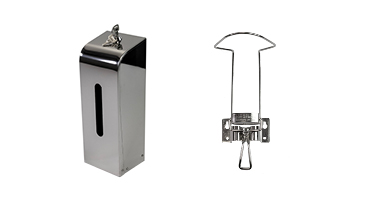
In the case-type dispenser, the refill pack is enclosed, while in the frame-type dispenser, it is exposed. The forearm lever is longer than the palm lever and can also be pressed with the forearm.
Double wiring
The electrical outlet has power, even when the light is turned off.
Double-sided mirror
The mirror cabinet doors have a mirror surface on both sides.
Dry film thickness mm
Dry film thickness is a product information related to waterproofing. The value is product-specific and is usually related to the waterproofing system certification and test results. The value indicates the minimum dry film thickness that achieves watertightness and/or other tested property.
Edgebanding material
The sink cabinets have ABS edge banding, which is attached with PU glue. This ensures the best possible moisture protection. In addition, there are grommets available for holes drilled through the frame parts, which, when installed according to instructions, minimize the risk of moisture damage.
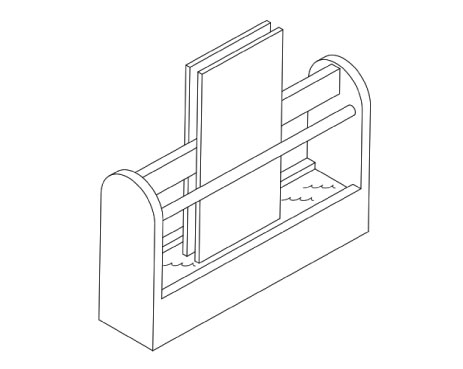
In the picture: a sketch of test conditions where the edges of the furniture are kept in water."
Electric input
The location of the electrical junction box in the product.
Environmental Product Declaration (EPD)
An EPD (Environmental Product Declaration) is a voluntary and standardized method based on life cycle analysis to reliably present essential, verified, and comparable information on the environmental impacts of a manufactured product or product group.
Extended open time
The E classification of the EN 12004 standard for fixing mortars means that, when combed out onto the substrate, the mortar has an open time of at least 30 minutes under normal conditions. The extended open time reduces the risk of skinning, thus improving the quality and final result of the installation.
Factory set flush volume liters
The product's flush volumes for large and small flushes with the original factory settings. The flush volumes are usually adjustable, but the limits vary depending on the product.
False joint
Pre-cut joint Yes indicates that the surface of the individual tile is grooved for jointing.
Thus, during the grouting of the tiling, the grout that fills the grooves alters the overall appearance, so that the tiled surface achieves a visual result different from the size of the individual tiles. For example, the finished surface may resemble a mosaic, even though the individual tile is 20x40 cm.
The minimum grout width value in millimeters indicates how wide the joint between the tiles should be at a minimum. To ensure the overall appearance of the finished tiling is uniform, the joint between the tiles should align with the pre-cut joints.
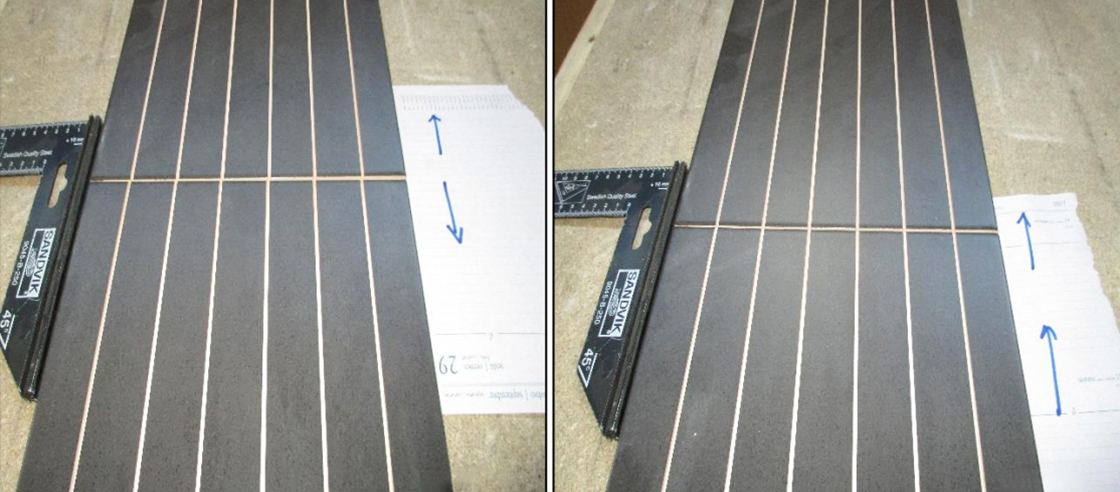
If the pre-cut joints of the tiles do not align (left image), it may be necessary to rotate the tile 180º.
The joints between the tiles, as well as the pre-cut joints on the tile surface, are over-grouted to create a uniform appearance for the tiling.
Fast product
The hardening and drying time of the instant product is shorter than that of a normal equivalent product, which is why it is well suited for various small repair and patching jobs, as well as for projects where you want to progress quickly in terms of schedule.
Due to the faster hardening, the instant product is characterized by a shorter pot life than normal.
Fast-curing
The F classification of the EN 12004 standard for fixing mortars means that the mortar is fast-hardening and, under normal conditions, reaches an adhesive strength of 0.5 MPa within six hours of installation.
Fire class
The fire classifications of building materials (excluding floor coverings) are A1, A2, B, C, D, E, F.
Smoke production and dripping are indicated by the additional classifications s and d. The classification for smoke production is s1, s2, s3, and for dripping d0, d1, d2..
A1 Materials that do not contribute to the fire at all
A2 Materials with very limited contribution to the fire.
B Materials with very limited involvement in the fire.
C Materials with limited contribution to the fire.
D Materials whose contribution to the fire is acceptable.
E Materials whose behavior in a fire is acceptable.
F Materials whose behavior has not been determined.
s1 Smoke production is very limited.
s2 Smoke production is limited.
s3 Smoke production does not meet the requirements of s1 or s2.
d0 No flaming droplets or particles occur.
d1 Flaming droplets or particles extinguish quickly.
d2 The production of flaming droplets or particles does not meet the requirements of d0 or d1.
Classes A1 and F always appear without additional classifications. E without an additional classification means that the material does not produce flaming droplets. All other classes also include additional classifications, e.g. A2-s1, d0, B-s1, d0, D-s2, d2, E-d2.
The classifications of floor coverings are indicated by: A1FL, A2FL, BFL, CFL, DFL, EFL, FFL.
Smoke production is indicated by the additional classifications s1 or s2
A1 FL Materials that do not contribute to the fire at all.
A2 FL Materials with very limited contribution to the fire.
B FL Materials with very limited involvement in the fire.
C FL Materials with limited contribution to the fire.
D FL Materials whose contribution to the fire is acceptable.
E FL Materials whose behavior in a fire is acceptable.
F FL Materials whose behavior has not been determined.
s1 Smoke production is limited.
s2 Smoke production does not meet the s1 requirements
Source: RakMK E1
Flow rate l/min at 3 bar pressure
The flow rate indicates the amount of water coming from the water fixture at 3 bar pressure. The stated value is the maximum possible amount in liters per minute.
Flush mechanism
The flushing mechanism consists of a flushing valve and button.
Single flush
The product has a single flushing feature with a fixed flush volume.
Dual flush
The product has two flushing options, a large and a small flush, each with different flush volumes. For example, the large flush may be 6 l/min, and the small flush 4.5 l/min, allowing water usage to be limited based on the need.
Automatic flush (urinals)
The product has a sensor that detects the need to flush, and the flushing starts automatically.
Flush technology
Toilet flushing describes the way in which a toilet is flushed. There are two common flushing techniques for toilets: rimmed and rimless. In addition, urinals have completely waterless flushing solutions.
With flushing rim
Rimmed flushing is a traditional flushing technique where water flows inside the rims at the top of the toilet bowl and flows under the rims into the bowl.
Without flushing rim/Rimless
Rimless flushing is a newer technique where the toilet bowl does not have a flushing rim. The edges of the bowl have grooves along which water flows around the bowl through a water guide at the back edge. The advantages of rimless flushing include easier cleaning and efficient flushing.
Waterless
Waterless flushing is a flushing technique used in urinals. For example, waterless urinals contain a tank containing citric acid instead of a traditional water flush.
Fold measurement
Indicates the length of the fold (A) in corner tiles or the height of the front edge (B) of a stair tile.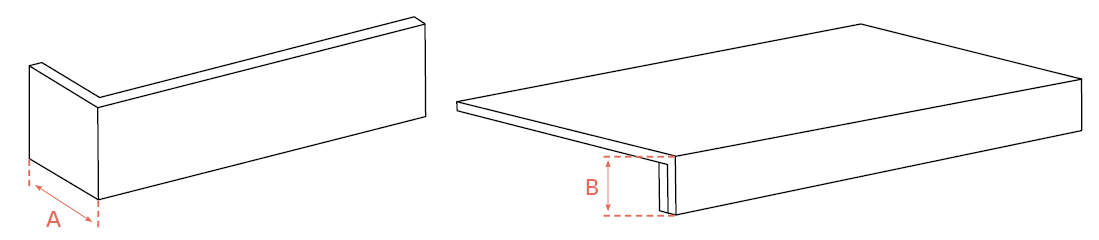
Frost resistant
Ceramic tiles
The frost resistance of a tile is related to how much water the tile absorbs. Frost-resistant tiles, i.e., ceramic tiles with a water absorption rate of less than 1%, are suitable for outdoor use.Frost-resistant tiles are manufactured in such a way that water cannot penetrate their pores and freeze, which could cause the tile to crack.
In order for outdoor tiling to withstand frost, it must be installed correctly, and the tiling technique used must also be frost-resistant.
Textile and vinyl coverings
Vinyl and textile tiles are not frost-resistant, which is why they are only suitable for warm and dry indoor areas. They are also not suitable for spaces that are cold for part of the year, such as summer cottages.
Gloss level
Ceramic tiles
A ceramic tile can have either a glossy or matte appearance. This is influenced by the '"glazing of the tile", but the surface of the tile can also be treated separately to achieve these visual effects.
| Value | Description of value | |
| Glossy | The tile's surface shines because it has a glossy glaze. | 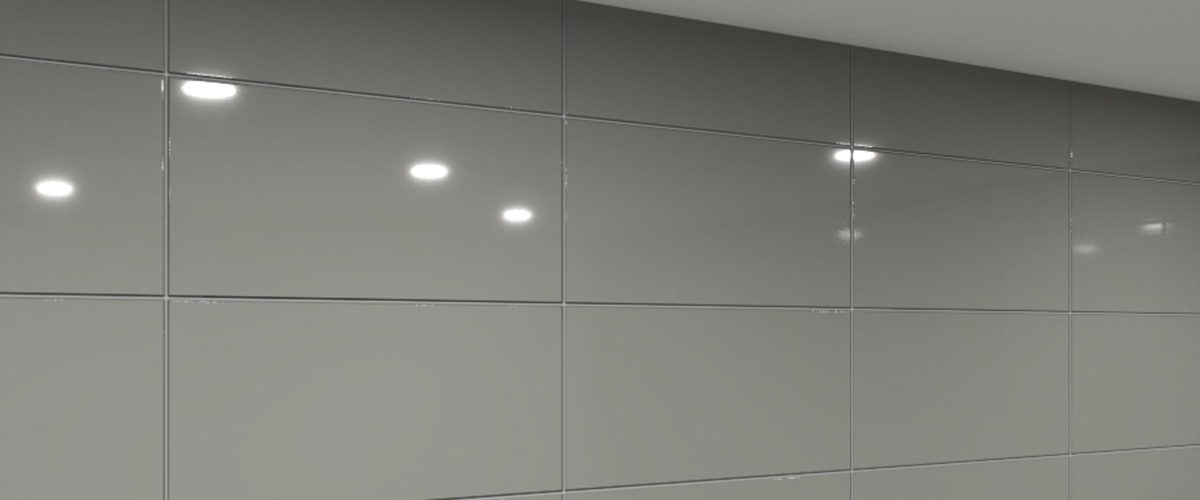 |
| Polished | The tile's surface shines because it has been polished using a grinding technique. The tile can be either unglazed or glazed and then polished. | 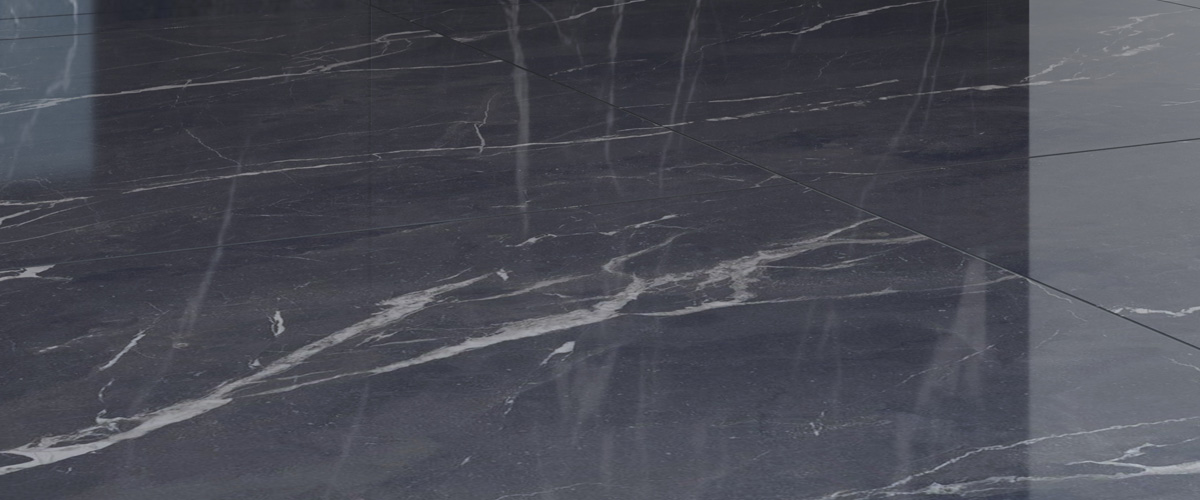 |
| Honed | The tile's surface is partially polished using a grinding technique. The tile can be either unglazed or glazed and then partially polished using this technique. | 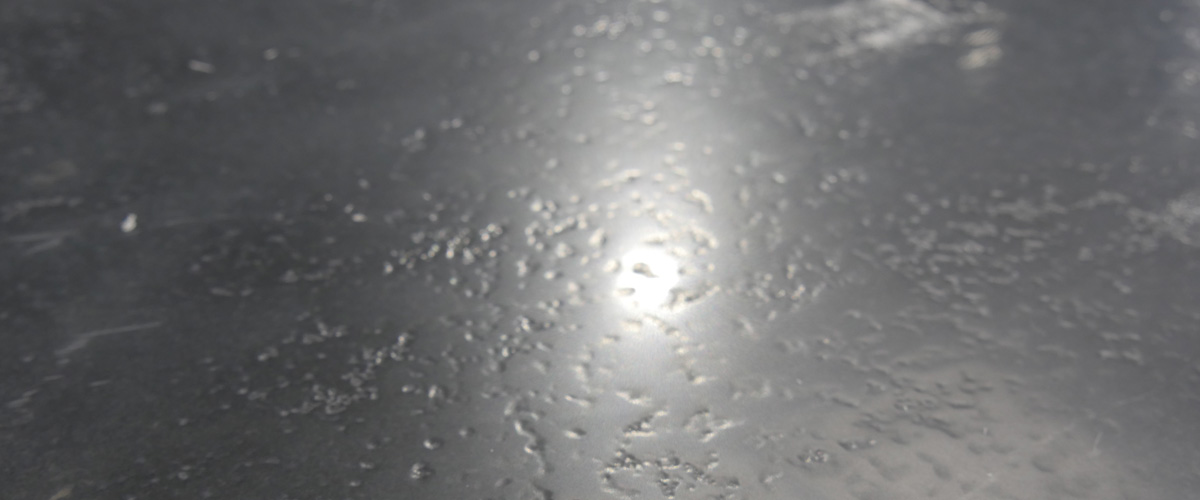 |
| Satin | The surface of the tile is not glossy; instead, it feels and appears silky smooth. The tile can be unglazed or glazed. The satin finish is achieved through a grinding technique. | 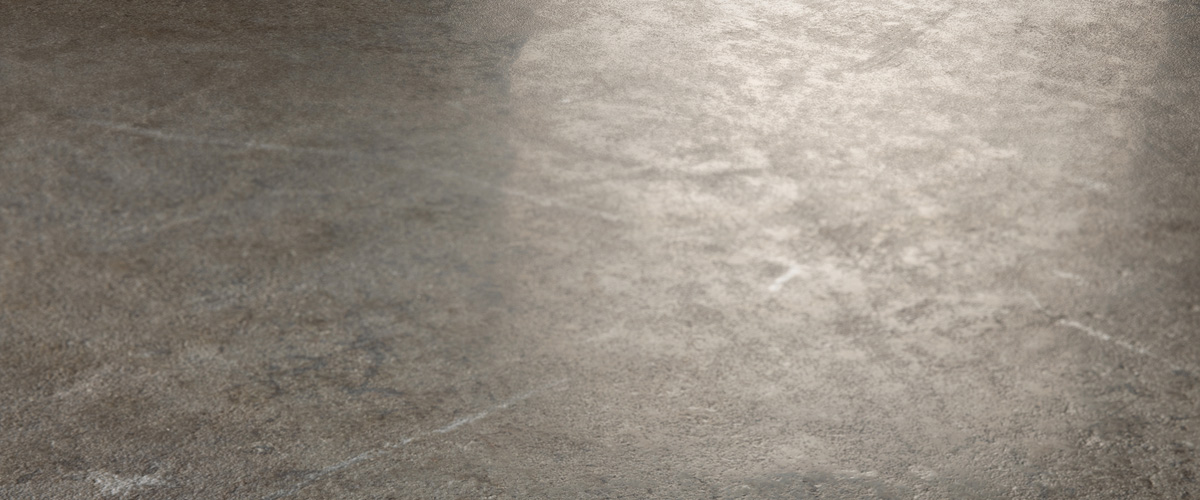 |
| Matt | To achieve a matt appearance, the tile's surface is either unglazed, unpolished, or matt-glazed. | 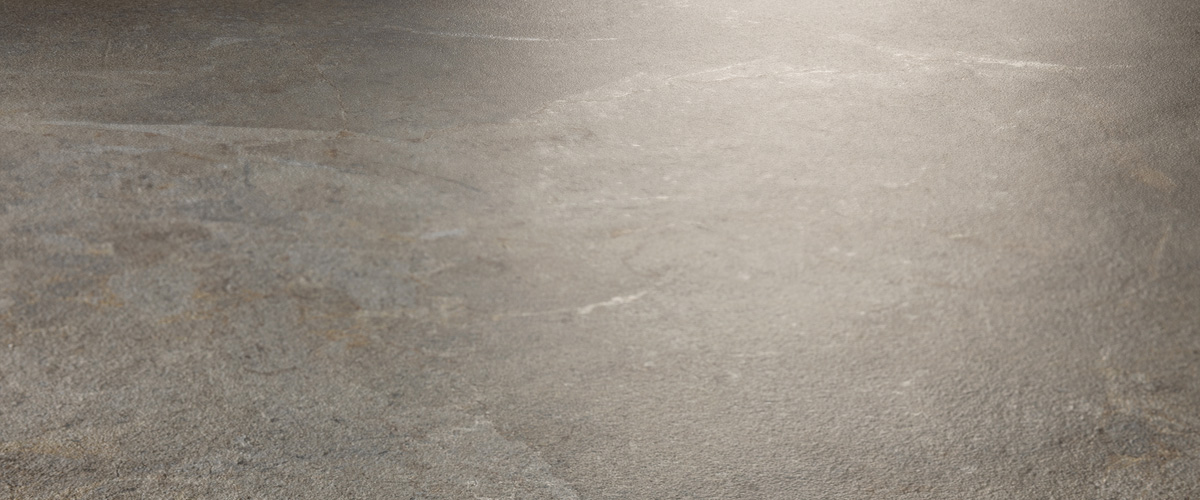 |
Vinyl planks and vinyl tiles
The gloss level of a vinyl floor can be adjusted during production through surface treatment. A matte finish, for example, gives wood-patterned vinyl flooring a more authentic wood floor appearance
Grout protection (optional step)
The absorbency/tightness of cement-based joints varies depending on the product, but a cement-based joint is never completely waterproof. Protecting the joints is not mandatory, but treating them with a protective agent reduces the absorption of water and consequently stains on the joint surface, making it easier to keep the joints clean and to clean them. The protective agent for the joints wears off with use, so it is advisable to renew it every 2-3 years depending on the usage stress of the space.
Hand shower spray modes
The hand shower offers one or more spray modes, affecting the water flow and shower experience.
- Rain – A steady and soft spray that mimics natural rainfall.
- SmartRain – A water-saving version of Rain, optimized for lower water consumption.
- Jet – A powerful and focused spray, ideal for massage or intensive rinsing.
- Massage – A rotating and rhythmic spray that helps relax muscles.
- ActiveRain – An improved rainfall spray with larger, softer drops for a more luxurious shower experience.
- PureRain – An innovative spray that massages tense muscles or rinses shampoo effectively.
- PowderRain – An ultra-soft and relaxing spray with microfine droplets.
Height adjustable
The height-adjustable product can be raised or lowered according to the user's needs after installation. It is possible to convert the height-adjustable product to a quick height-adjustable product with a separate adjustment lever. The package includes an adjustment lever for the quick height-adjustable product.
Hinging
The handedness of the furniture as viewed from the outside.
Includes mood lighting
Interior lighting of the furniture.
Indoor/Outdoor
The product's properties determine whether the product is suitable for use outdoors as well as indoors. If the product cannot withstand cold conditions/freezing or the product's properties change significantly when the temperature changes, the product is generally not recommended for use outdoors.
The conditions in different outdoor spaces vary. Some spaces may be covered, others completely at the mercy of the weather, which exposes them to different stresses. Depending on the product, it is possible that the product can be used outdoors on vertical surfaces, but not horizontal surfaces.
Installation direction/pattern
Textile and Vinyl Floors
Product-specific guidance on installation direction indicates how the products are recommended to be laid. Attention should be paid to the arrow on the back of the product during installation. Be sure to carefully review the product's installation instructions.
Unidirectional installation The products are installed with the backing arrows pointing in the same direction.
Row installation The products are installed with the backing arrows pointing in the same direction. Depending on the shape of the product, there are different overlap recommendations. Refer to the installation instructions for more details.
Brick pattern installation The products are installed with the backing arrows pointing in the same direction. Depending on the shape of the product, there are different overlap recommendations. Refer to the installation instructions for more details.
Checkerboard installation The products are at a 90-degree angle to each other.
Direction-free installation The direction of the backing arrows is not considered during product installation.
Herringbone installation The products are installed in a herringbone pattern. Refer to the installation instructions for more details.
Installation method
The installation method tells you where the product can be attached or installed.
Intended use
Ceramic tiles
Ceramic tiles can be used as a surface material on walls, floors, outdoor areas, or swimming pools, depending on their properties. Ceramic tiles are tested according to various ceramic standards as evidence of their suitability for the aforementioned applications. Laattapiste's recommendations always meet at least the standard requirements, but thanks to our excellent user experience, we can also recommend products with stricter criteria.
Textile and vinyl coverings
Vinyl tiles, textile tiles, and wall-to-wall carpets are suitable for floor use. The abrasion resistance class indicates the level of stress the product has been tested to withstand on the floor. Woven vinyl wallpaper, on the other hand, is planned for wall use.
IP rating
An IP class has been defined for electrical devices installed in the bathroom, which indicates the type of environment in which the electrical device may be used. You can read the instructions specified by TUKES here.
Kelvin max
Kelvin max indicates the maximum value of the light color temperature.
The color temperature of light fixtures is described by the Kelvin scale.
On the scale, 2,000 Kelvin represents a very warm, almost reddish light, while 6,000 Kelvin represents a very cool, almost bluish light.

Light measurement definitions
| Watt (W) | Power | Dansani uses energy-efficient, 350mA constant voltage. |
| Kelvin (K) | Color temperature | The color temperature of a candle is 2,700K. Dansani uses this slightly whiter but warm color temperature of 3,000–3,150K to achieve the best result. |
| Lux (lx) | Illuminance | The amount of luminous flux hitting a specific surface. Dansani provides measured values as reference values for all 60 cm wide mirrors and mirror cabinets. |
| Luumen (lm) | Luminous flux | The total amount of light produced by the light source and the portion of the light flux that has the ability to produce a visual sensation in the eye. It is a relatively theoretical value that does not account for factors such as shadows or the design of the light fixture. |
| CRI or Ra | Color rendering index (CRI) | The light source's ability to reproduce certain test colors in relation to a given reference light source at a specified color temperature. The CRI value of Multiwhite products is at least 90. |
Lateral load kg
Load capacity determines how much weight a product can withstand in a lateral direction without showing the first signs of damage.
Load capacity kg
Load capacity determines how much weight a product can withstand vertically without showing the first signs of damage.
Location of flush button
Location of the flush button on a wall-mounted toilet element. The flush button is usually installed on the front of the element, but in a low element it is also possible to install the button on top of the element.
Locking
The product can be locked with a key. The package includes a key.
Low dustiness
Low Dust mortar products have been developed to produce less fine dust during application, especially during mixing. This feature improves the working environment from both the installer and dust control perspectives.
Luminous intensity in lumens
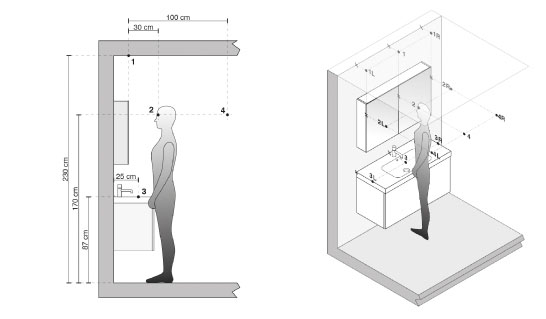
Dansani is continuously developing its LED lighting and fixtures. By defining the light quality, color temperature, and other important features, the best possible lighting quality can be ensured.
The properties of light can range from bright task lighting to soft, indirect ambient lighting. To meet various preferences, Dansani has developed several fixtures and light sources, each with different features and designs. The light output of the fixtures is shown in the table below.
Dansani has also developed a method to provide more detailed information about the amount of light and its properties. Detailed lighting values are available for all Dansani products that feature lighting. These values indicate and show the light intensity at several different measurement points, such as above the sink, at eye level, and further into the room.
| Light measurement definitions | ||
| Watt (W) | Power | Dansani uses energy-efficient, 350mA constant voltage. |
| Kelvin (K) | Color temperature |
The candlelight color temperature is 2,700K. Dansani uses this slightly whiter but still warm color temperature of 3,000–3,150K to achieve the best result. |
| Lux (lx) | Illuminance | The amount of light flux striking a specific surface. Dansani provides measured values as reference values for all 60 cm wide mirrors and mirror cabinets. |
| Luumen (lm) | Valovirta | Valolähteen tuottama kokonaisvalomäärä ja se osa valovirrasta, jolla on kyky tuottaa silmässä valoaistimus. Suhteellisen teoreettinen arvo, joka ei huomioi esimerkiksi varjoja tai valaisimen muotoilua. |
| CRI or Ra | Color rendering index | The ability of a light source to reproduce specific test colors in relation to a given reference light source at a specified color temperature. The CRI value of Multiwhite products is at least 90. |
| Light measurements | 1. CEILING Indirect light |
2. EYES Face height |
3. TABLE Task light |
4. ROOM Ambient light |
|
| Mido | |||||
| 1 | 60 cm mirror with integrated lighting | 197 | 408 | 173 | 92 |
| 2 | 60 cm framed mirror with two light fixtures | 26 | 302 | 76 | 28 |
| 3.1 | 60 cm mirror cabinet with integrated lighting | 747 | 154 | 5 | 60 |
| 3.2 | 60 cm mirror cabinet with integrated lighting and bottom light | 747 | 169 | 428 | 60 |
The values in the table are in lux. See more information on light measurements: www.dansani.fi.
Luxury class
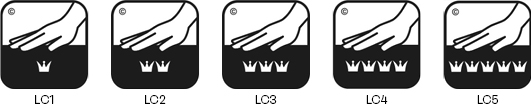
The Luxury Class refers to the softness and plushness of the carpet. The carpets are classified according to their level of luxury with crown symbols.
The highest luxury class is five, symbolized by five crowns. The luxury class is part of the EN 1307 classification.
Manufacturing method
The basic types of ceramic tiles are wall tile, floor tile, and porcelain stoneware, each with its own manufacturing technique. Tiles can be produced using dry-pressing or extrured methods, and they can be either glazed or unglazed, depending on the basic type. By exploring the characteristics of different tile types, the most suitable product for a specific application can be found.
The basic tile characteristics of the first-quality ceramic tiles are defined in the ceramic harmonized standard SFS-EN 14411.
The tiles are CE marked, and a Declaration of Performance (DoP) is issued for them.
The properties of ceramic tiles are tested according to the testing methods outlined in the different sections of SFS-EN ISO 10545. In the first-quality selection, a sorting defect pieces is allowed 5 %, meaning that visible defects may be present in five percent of the tiles. These can be removed during the tiling process, or a good part of the tile can be used when cut, for example, in corners.
Products outside the standard include items used similarly to ceramic tiles, such as glass products, agglomerates, cladding stones, hand-forged terracotta tiles, and natural stones. The manufacturers of these products define their properties and suitability.
Material of toilet seat cover
The material from which the toilet seat cover is made.
Mesh backing
Smaller tiles, under the 10x10 size, may be glued on mesh and mosaics are fixed by mesh backing to speed up the tiling process. The mesh backing indicates how the tiles are meshed to each other. We provide this information for all tiles under 10x10 cm in the 'Mesh Backing' section.
| Value | Value description | |
| With fiberglass mesh | The tiles are glued to a thin fiberglass mesh, which remains between the adhesive and the tile during the tiling process. | |
| With adhesive dot sheet | There is a silicone adhesive dot between the individual tiles, which connects the tiles to form a tile sheet. | |
| Paper sheet on the top of tiles | A paper is glued onto the tiles to help transfer them onto the adhesive. Once the tiles are installed to the substrate, the paper is soaked and removed before grouting the tiles. | |
| With paper sheet | The tiles are glued to a thin paper net, which remains between the adhesive and the tile during the tiling process. For this reason, the product is not suitable for wet areas. | |
| Split clinker | In split clinker, two pieces are still stucked to each other after the manufacturing process and are separated before installation by bending the pieces apart along the joint between them. |
|
| Loose piece | The tiles are loose pieces from each other for installation and are laid individually during the tiling process. |
Minimum joint width mm
Depending on the manufacturing method and dimensional accuracy of the tiles, different joint widths are used during the tiling process for different tiles. The purpose of the tile joint is to compensate for tile-specific dimensional and shape tolerances resulting from manufacturing. The shape tolerance of the tiles does not always allow for very narrow joints. The minimum joint width is determined by the dimensional tolerances of the selected tile.
With the product-specific joint width recommendation, we indicate the minimum width required for tiling each tile. However, it is always advisable to perform a test layout to ensure the suitability of the intended joint width for the tiling.
0 mm joint width is never recommended.
The recommended joint width information for tiles is also used to calculate the estimated consumption of grout.
Mixing ratio
The mixing ratio of the product to either water or additive according to the product instructions.
The correct mixing ratio is an essential factor for the correct functionality of the product. Too little or too much water in relation to the amount of dry matter affects the installation of the product and often changes its properties in a harmful way.
Model of floor WC
Floor-mounted toilet seat drainage type.
S-trap
The drainage of an S-trap toilet seat is vertical and therefore the product can only be drained to the floor. S-trap toilets are divided into two groups: hidden and open, which practically means whether the drain connection is visible outside the toilet seat.
P-trap
The drainage of a P-trap toilet seat is horizontal, which allows the product to be drained to the wall. It is also possible to drain a P-trap toilet seat to the floor using a separate drain connection.
Modular tile
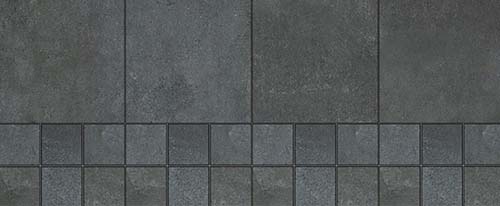
Modularity means that different tile sizes in a tile series can be combined with each other so that the joints align. For example, a 30x30 cm tile can be aligned with the grout lines of three 10x10 cm tiles.
Mono caliber
Monocaliber tiles are tiles that are always manufactured in one size. Monocaliber tiles are not classified by size, as is done in caliber classification (see more information under dimensional accuracy). Therefore, products of the same size within the same series are compatible with each other. A consistent size allows for the combination of different colored products from the same series during installation.
Example of installing two monocaliber products of the same size but different colors: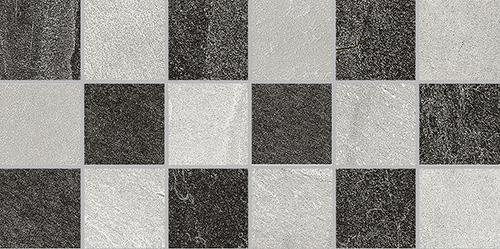
Mortar bed
The coverage of the adhesive layer must be 100%, in order avoid that behind of tile don't start to collect water in the adhesive layer which can appear as darker areas in the finished tiling. In demanding applications, 100% adhesion can be ensured by using a double-bonding method. In double-bonding, the adhesive mortar is applied not only to the substrate but also to the tile being installed.
The tiles are placed into the wet adhesive and adhesion is ensured, as well as the removal of air from beneath the tiles, by tapping them with a rubber mallet or by lightly pressing the tiles against the adhesive. If the tile to be installed was applied on a mesh sheet, like mosaics, tapping helps to ensure that the mosaics adhere in the correct position.
Installing mosaics is done from top to bottom, and to prevent slipping, the sheets can be attached with tape to upper structures. When tiling pools, the installation of sheets starts at the shallow end and progresses towards the deeper end. Installing mosaics in corners is left for a later stage of the work.
Excess adhesive that has oozed out from the joints should be removed while still fresh, for example with a piece of cardboard, so that there is enough space left for the grout.
Refer to the adhesive mortar installation instructions.
Nano-coated glass
Nano-coated glass has a special protective coating on the inside, which makes cleaning easier.
Non-flowing
The T classification of the EN 12004 standard for fixing mortars means that the mortar composition is thixotropic, i.e. non-sag, so that on a vertical surface the test tile may not sag by more than 0.5 mm.
This property is useful for tiling walls and other vertical surfaces.
Number of functions
The number of functions indicates how many separate water outlets the mixer has. These outlets can be connected to, for example, an overhead shower, a hand shower, or a bathtub spout, allowing multiple functions to be used from a single mixer.
Number of pattern variations
The number of pattern variations indicates how many different surface patterns have been used in the production of the product. For example, if the number of pattern variations is 25, it means that every twenty-fifth tile has the same pattern.
Number of structural variations
The number of structural variations indicates how many different molds have been used in the production of the product's surface shape. For example, if the number of structural variations is 8, it means that every eighth tile has the same surface structure.
Number of tap holes
The number of tap holes in the product.
Open time in minutes
The open time of fixing mortars is the time within which the surface material must be installed in the mortar that has been combed out on the substrate. After the open time has expired, the surface of the mortar will become leathery, and the tile will no longer adhere to the mortar as desired and the adhesion will be weak.
A leathery surface of the fixing mortar during the installation phase is a common underlying cause of tile detachment, which is why the matter must be monitored continuously during the installation process. Temperature and humidity conditions can significantly affect the open time. For fast-setting products, the open time is shorter than normal.
Operating time in minutes
Pot life of the ready-mixed product in minutes. Pot life may vary depending on site conditions. Factors that affect pot life include, for example, air temperature, humidity, and the temperature of the mixing water or products.
Pattern
Pattern describes the overall appearance or style of the surface material, which the surface pattern imitates.
PEI abrasion resistance
The SFS EN 14411 ceramic standard EN ISO 10545-7 PEI rating indicates the surface abrasion resistance of the glazed tile on a scale from 0 to 5. The higher the number, the better surface abrasion resistance. Light colors generally have better surface abrasion resistance than darker colors. The PEI rating is determined only for glazed floor tiles.
Examples of usage areas:
| Value | Explanation of value |
| PEI 1 | Home floors, use without shoes |
| PEI 2 | Home floors, use with soft-soled shoes |
| PEI 3 | All home floors as well as light floor use in commercial spaces |
| PEI 4 | Medium-heavy use in commercial spaces and light industrial use, institutional use |
| PEI 5 | Very heavy use |
Percentage of post-consumer recycled material
Indicates how much material recycled from post-consumer use has been used in the product. (Post-Consumer)
Percentage of post-consumer recycled yarn
Indicates how much yarn recycled from post-consumer use has been used in the product. (Post-Consumer)
Percentage of pre-consumer recycled material
Indicates how much material recycled from production waste has been used in the product. (Pre-Consumer)
Percentage of pre-consumer recycled yarn
Indicates how much yarn recycled from production waste has been used in the product. (Pre-Consumer)
Percentage of recycled material
The percentage of recycled material in the raw materials used in the product.
Percentage of recycled yarn
The percentage of recycled yarn in the yarn used in the product.
Pile yarn
The yarn used in textile carpets is made from various synthetic and natural fibers. Examples of the most common textile fibers used in our textile floors and carpets:
Polyamide (PA)
- synthetic synthetic fiber, chemically produced from organic carbon-based chemicals
- another well-known name for polyamide is nylon
- different polyamides can be distinguished by a number after the name, e.g. PA 6.6 or PA 6, which indicates the number of carbon atoms that react with each other
- a very elastic, resilient, strong and wrinkle-free fiber that dries quickly
- good tensile and abrasion resistance
- the use of recycled polyamide is a way to reduce carbon dioxide emissions from the production of floor coverings
- the raw material for recycled polyamide is often surplus from the textile industry, old fishing nets or carpets
- polyamide is used as a material for carpets, especially in public spaces where very high wear resistance is required
Polyester (PES)
- synthetic man-made fiber, most often made chemically from polyethylene terephthalate (PET)
- elastic, strong, wrinkle-free, soft and resilient fiber, good abrasion resistance
- repels water and dries very quickly
Polypropylene (PP)
- synthetic man-made fiber, consists of ethylene, propylene or other alkenes
- a very strong fiber with good resistance to microorganisms and chemicals
- does not absorb moisture, but transports or evaporates moisture well, good thermal insulation
- one of the lightest fiber materials
Polyolefin (PO)
- synthetic fiber that does not absorb much water
- polyolefins include, among others polyethylene, polypropylene and elastodiene
Polyethylene terephthalate (PET)
- a durable and lightweight material
- for example, yarn made from recycled PET plastic bottles can be used in carpets
Wool
- wool is a protein fiber consisting mainly of keratin, which is shorn from sheep
- excellent thermal insulation, moisture transfer, flexibility and dyeability
- recovers well from stretching and compression, does not wrinkle easily
- repels water and dirt, and is naturally fireproof
- a wool carpet is natural, warm and long-lasting if well cared for
Dyeing of textile carpets
The yarn used in textile carpets is dyed using various methods, e.g.:
Through dyeing
- in the solution dye (SD) method, the dye is added at the fiber level before the yarn is manufactured
- even and durable dyeing results
- enables the creation of patterns with yarn
Yarn dyeing / piece dyeing
- in the piece dye (PD) method, a carpet made of white yarn is dyed by dipping it in a dyeing liquid
- allows for more agile custom carpet colors
Continuous dyeing
- a carpet made of white yarn is passed along a line where the dye is sprayed
Platform requirements
Ceramic tiles are installed to conventional tileable substrates, such as concrete, lightweight concrete, brick, sand lime brick, plaster, leveling compound, and board substrates. The tiling substrate must be even, clean, solid, and immobile.
Even substrate: The flatness requirement of the tiling substrate depends on the size of the tile (SISÄRYL 2013 Table 541).
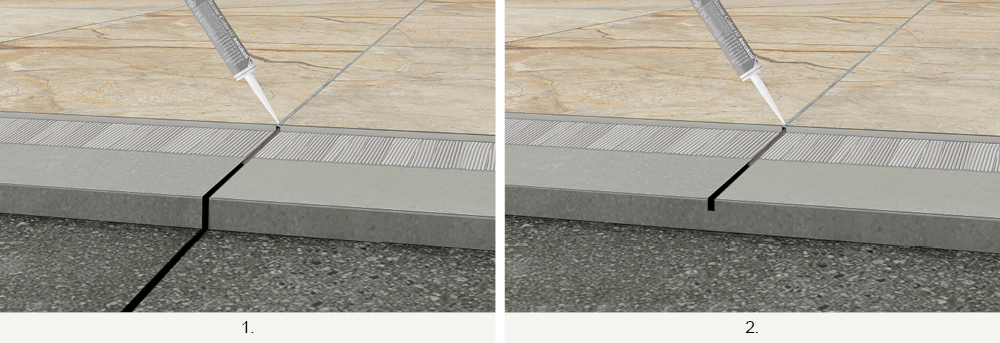
Immobile substrate: Most of the drying shrinkage must already have occurred in the concrete substrate. If the drying shrinkage has not yet reached a sufficient level, a still shrinking substrate will cause movement in the tile surface, resulting in the tiles detaching or cracking. Structural expansion joints (Figure 1) and substrate expansion joints (Figure 2) must always be considered and should not be covered by tiling.
Solid substrate: Any cracks in the substrate should be injected and floor castings should be done with a cement-based surface casting compound. The absorbent substrate should be primed before leveling work with a primer, according to the primer's instructions, taking into account the substrate's absorbency. If necessary, final leveling should be done with a leveling compound and the surface waterproofed materials.Familiarize yourself separately with the installation instructions for casting compounds, primers, leveling compounds, and waterproofing materials.
Clean substrate: The substrate must not contain any substances that weaken adhesion or cement slurry. The substrate should be cleaned using appropriate methods. For indoor air quality, it is desirable that the emission class of the materials used is M1 or EC1 Plus (GEV Emicode).
Installation to the substrate: The tiles are installed with mortars or tile adhesives according to the manufacturers' separate instructions. The temperature of the substrate and the products used must comply with the mortar manufacturer's instructions. Familiarize yourself separately with the instructions for the mortar.
Post-grouting wash
The finished tiled surface is washed after grouting, before the area is put into use. The post-grouting wash is done immediately once the tiling and grouting have fully cured.Please refer separately to the installation instructions for the adhesive and grout.
Washing after grouting is an essential part of tiling work. The washing can be done by the tiler or the person responsible for construction cleaning, but it cannot be omitted.
Post-grouting washing removes grout residue from the tile surface, reveals the tile's true appearance, and facilitates future maintenance cleaning. The importance of post-grouting washing (initial cleaning) is especially emphasized for bathroom floor tiles, whose surface is rougher for safety reasons compared to, for example, glossy wall tile.
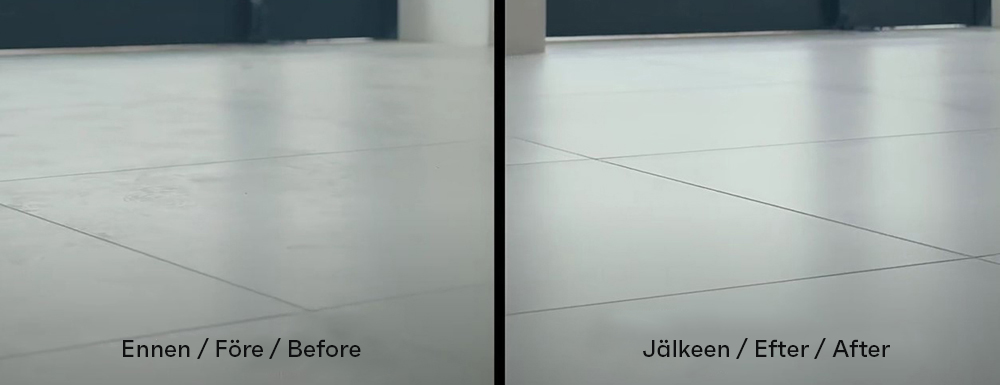
Grout residue is removed using the suitable acidic cleaner Fila Deterdek Pro. If the surface to be cleaned cannot withstand acidic cleaners (e.g., certain natural stones), an alkaline cleaner such as Fila PS87 Pro or a neutral cleaner such as Fila Cleaner Pro should be used according to the specific instructions. In unclear situations, always ensure the suitability of the cleaner by testing it on a small area first.
Work steps Fila Deterdek Pro
- Allow the grout to cure for the time specified by the product before performing the initial cleaning. Clean the surface of any loose debris and dirt, for example, by vacuuming.
- Pre-wet the surface to be cleaned, especially the joints, with water before using the acidic cleaner. This prevents the acidic cleaner from affecting the tile joints too strongly.
- Dilute Fila Deterdek Pro (1 part) with lukewarm water (10 parts). The effectiveness of the cleaner decreases when using colder water. If necessary, use a stronger mixture, for example, 1:5.
- When washing by hand, clean a few square meters at a time. Pour/spread the cleaning solution onto the surface, let it sit for at least 2–3 minutes, and then scrub with a white scouring pad or a scrubbing brush. Cleaning with a soft sponge or cloth may not effectively remove residues from the tile surface. On larger floor areas, scrubbing can also be done mechanically.
- After washing, thoroughly remove the dirty wash water from the surfaces and rinse with plenty of water. Carefully remove the rinse water as well and allow the surface to dry.
- Possible metal marks on the tile surface will be removed during the initial cleaning, which is carried out after grouting using an acidic detergent solution, for example Fila Deterdek. In this case, the cleaning solution is prepared using 1-part Deterdek and 3 parts water. During the initial cleaning, the solution is allowed to act on the tiled surface for a few minutes. Before the initial cleaning, the tile joints are thoroughly moistened, as acidic cleaning agents can etch cement-based grout joints. After washing with the Deterdek solution, the tiled surface is thoroughly rinsed and dried.
- Individual metal marks, for example those possibly caused by a squeegee, can also be removed using a silicate abrasive eraser.
Fila PS87 Pro for intensive cleaning of tiled surfaces
Fila PS87 Pro is suitable for cleaning, stain removal, and wax removal.
Diluted Fila PS87 Pro cleans and removes grease from heavily soiled various types of floor surfaces such as porcelain stoneware, other ceramics, and concrete. The product is ideally suited for deep cleaning of acid-sensitive stones.
In unclear situations, ensure the suitability of the cleaning agent by testing it on a small area.
Work steps Fila PS87 Pro
- Dilute in water at a ratio of 1:10–1:20 and apply to the surface (1 part cleaner, 10 parts water).
- Let the cleaning solution act for 4–5 minutes, then treat the surface with a floor cleaning machine or brush.
- Remove the residues with a wet vacuum or cloth and rinse thoroughly.
If more intensive cleaning is needed, dilute the cleaning solution to 1:5.
Fila Cleaner Pro neutral all-purpose cleaner
For ceramic tiles, stones, concrete, glass, and mirror surfaces.
Fila Cleaner Pro gently cleans all types of floors and surfaces. The cleaner does not damage treated or delicate surfaces.
Suitable for initial cleaning and maintenance of delicate surfaces such as metal and crackle tiles.
Work steps Fila Cleaner Pro
- The cleaning concentrate can be diluted to different strengths from 1:30 to 1:200 as needed (1 part cleaner, 30 parts water).
- When diluted at 1:200, no separate rinsing is required, as the product leaves no residue (e.g., when used with a floor cleaning machine).
- Stubborn dirt residues should be cleaned with a stronger solution diluted 1:30–1:50.
- Clean the surface with the cleaning solution using a cloth or brush.
- Remove the dirt and rinse the surface thoroughly.
Power source for electronic tap
Electronic faucets are divided into two groups:
230V/12V (plug with transformer)
The faucet includes a transformer and is connected to an electrical outlet via a plug.
Battery-operated
The faucet is powered by a battery.
Preloading
Pre-laying refers to the planning work of tiling done before the actual installation. During this process, the tiles are removed from their packagings and laid out, or arranged, in the way they will be permanently installed. The color variation of the product significantly affects how many tile packages need to be open, sorted and mixed together during the pre-laying installation.
During the pre-laying installation, the quality of individual pieces is also checked, and any defective pieces are not used or included in the final tiling work.
During the pre-laying installation, the desired overlap of the products and the alignment of pre-cut tiles are planned, as well as the grout joint widths between the tiles and tile sheets. The grout joint width is significantly influenced by the small dimensional variations, or tolerances, between the pieces due to the manufacturing process. The planning of the tiling work also takes into account any expansion joints and their impact on the tile installation work.
The tiling work, meaning the installation of the tiles, can only begin after careful pre-laying and planning.
Production batches mixable
Ceramic tiles, as well as textile and vinyl floors, are characterized by color shade variation between production batches. To ensure a uniform and beautiful final result, different production batches should not be mixed, unless specifically allowed for the product. The products are manufactured in batches and are labeled with production batch identifiers. The identifier may be marked with letters, numbers, or a combination of letters and numbers. The production batch numbers are checked before the installation work begins to ensure that all products being installed in the same area are from the same production batch.
Pumpable
The product manufacturer determines the installation methods suitable for their product based on the product's properties. Pumpable products can be applied using a pump suitable for the product's properties instead of manual application. The type of pump and operating settings are determined on a case-by-case basis.
Quick release toilet seat cover
Find out if the toilet seat cover has a quick-release feature, which allows the cover to be easily removed. There are different quick-release mechanisms, some models release the cover with buttons at the ends of the hinges, while others have, for example, removable screws at the ends of the hinges. The biggest advantage of quick-release is that it makes cleaning the toilet easier when the cover can be easily removed.
Recommended flooring fixing method
The recommended adhesive for installing the product to floor surfaces. The recommendation is an example and is based on the properties of the selected tile (manufacturing method and intended use). Use adhesives that comply with the SFS-EN 12004 standard for tiling work, and pay special attention to installation sites that differ from the usual or require more demanding conditions, such as swimming pools.
The calculated consumption is estimated for the floor surface and the selected tile size. However, the consumption may vary as there are many site-specific factors that can affect the final consumption. The tiles are recommended to be installed with complete adhesive coverage to ensure a durable tiling and to withstand the various point loads applied to the floor surface.
Refer to the installation instructions of the adhesive mortar.
Recommended grout / grout color
Grouting has a significant impact on the final appearance of the tiling. Using a grout color that strongly contrasts with the tile’s shade will highlight the graphic appearance of the tiling, while a neutral grout color that matches the tile’s main color will create a calmer look. In mosaic tiling, the number of joints is high, which makes the grout color even more important.
Grouting can also affect the technical properties of the tiling. For example, an epoxy grout is required for an antibacterial tile surface.
The grout color recommendation from Laattapiste includes both visual and technical perspectives. From a technical standpoint, for unglazed, matte, polished, and structured tiles, it is recommended to use a grout color that is close to the tile color. When using grout colors that strongly contrast with the tile's shade, it is recommended to first perform a test grout. The grout color recommendations are based on the tile manufacturer's and/or Laattapiste's suggestions for the specific tile. From a visual perspective, the grout color recommendation is a guideline, and deviations from the recommendation are allowed if desired.
Always use grout materials that comply with the SFS-EN 13888 standard.

Elastic joints
Silicone sealant is applied according to the instructions to the movement joints of the tile field (Figure 1), as well as to flexible perimeter joints (Figure 2) and material boundaries. The approximate size of a tile field can be considered to be approximately 3x3 m or 8-12 m2, taking into account the shape of the space. Flexible perimeter joints include, among others, various tile penetrations, corners, and the junctions between walls and floors.
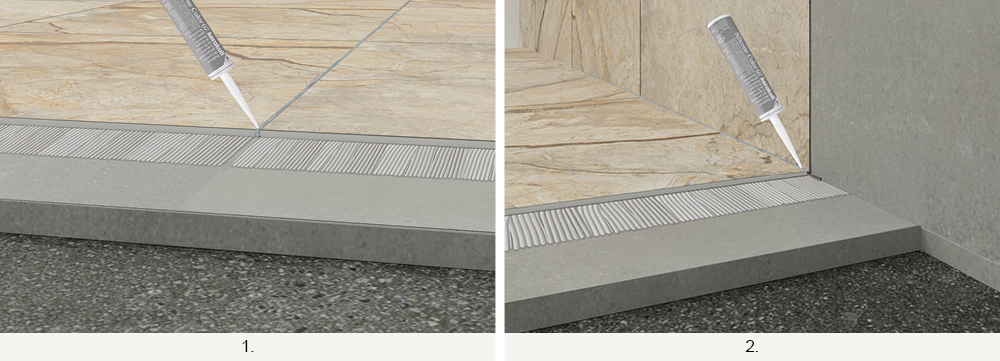
For sensitive materials, such as wood, natural stone, and mirrored glass, a suitable neutral silicone should be used. Neutral silicone does not contain ingredients, such as vinegar, that can be absorbed by sensitive materials. Before applying the silicone, the installer should ensure that the silicone sealant is compatible with the adjacent surface materials.
The Laattapiste-Pukkila grout color recommendation also includes a color recommendation for silicone sealant, but not all grout colors are available in neutral silicone sealants.
Refer to the installation instructions for the grout and silicone during the installation process.
Recommended outdoor fixing method
The recommended adhesive for installing the product in outdoor areas. The recommendation is a general example and is based on the properties of the selected tile (manufacturing method and intended use). Use adhesives that comply with the SFS-EN 12004 standard for tiling work, and pay special attention to installation sites that differ from the usual or require more demanding conditions, such as swimming pools.
The calculated consumption is estimated for outdoor areas and the selected tile size. However, the consumption may vary as there are many site-specific factors that can affect the final consumption.The tiles are recommended to be installed with complete adhesive coverage to ensure a durable tiling and to prevent voids in the mortar layer that can collect water, which in winter conditions may freeze and damage the tiling. Especially in outdoor areas, we recommend using the double bonding technique for tiling.
Refer to the installation instructions for the adhesive mortar.
Recommended use of leveling system
The use of leveling systems minimizes any lippage between tile edges on the finished surface. The leveling system can be used on both floor and wall surfaces. The use of leveling systems is especially recommended for large-format tiles.
Recommended wall fixing method
The recommended adhesive for installing the product to wall surfaces. The recommendation is an example and is based on the properties of the selected tile (manufacturing method and intended use). Use adhesives that comply with the SFS-EN 12004 standard for tiling work, and pay special attention to installation sites that differ from the usual or require more demanding conditions, such as stove backs and swimming pools.
The calculated consumption is estimated for the wall surface and the selected tile size. However, the consumption may vary as there are many site-specific factors that can affect the final consumption. The tiles are recommended to be installed with complete adhesive coverage to ensure a durable tiling and to prevent water from accumulating behind the tiles on wet room walls.
Refer to the installation instructions of the adhesive mortar.
Recycled material class
The recycling material category indicates the minimum percentage of recycled material in the product's raw materials. The exact percentage of recycled material is shown in the product information field "Percentage of Recycled Material."
We have categorized the classes as follows:
| Minimum percentage of recycled material 15 % |  |
|
Minimum percentage of recycled material 30 % |
 |
| Minimum percentage of recycled material 50 % |  |
Resistance to deformation
The standard EN 12004 classification S1 or S2 for adhesive mortars indicates the mortar's resistance to deformation.
S1 = resistance to deformation/flexure test of at least 2,5 mm
S2 = resistance to deformation/flexure test of at least 5 mm
Mortars without S-rating are less likely to absorb possible deformation of the substrate and/or tile, which may increase the risk of tile loosening.
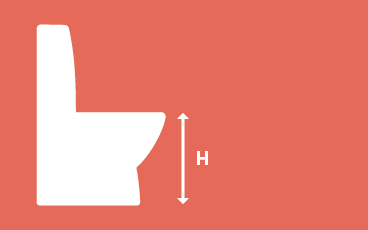
Seat height cm
The seat height of a toilet is the distance measured from the top of the toilet bowl to the finished floor. A toilet seat cover raises the seat height by approximately 1-5 cm, depending on the model.
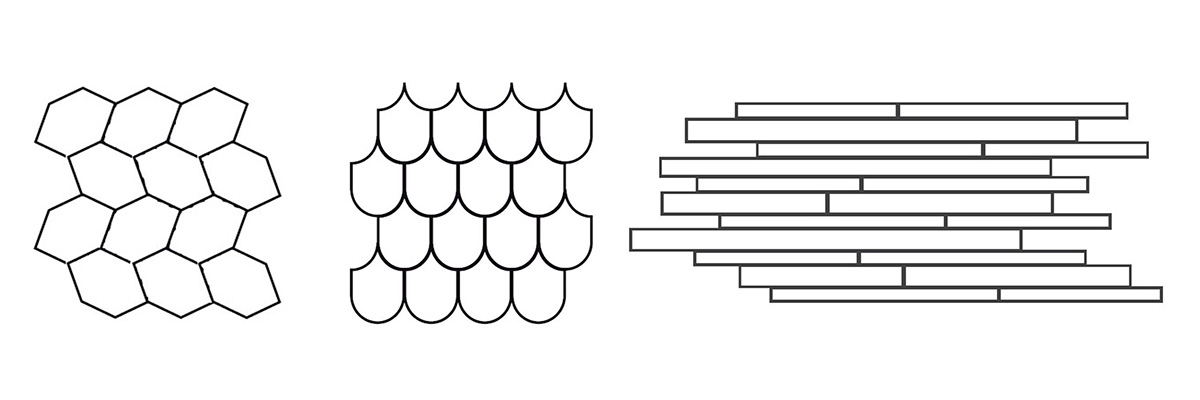
Shape
The "shape" of the surface material indicates the visual shape that stands out to the eye on the finished surface. The shape information also describes the shape of the individual piece of surface material. Sometimes an individual piece may have a different shape than the visual shape that stands out on the finished surface.
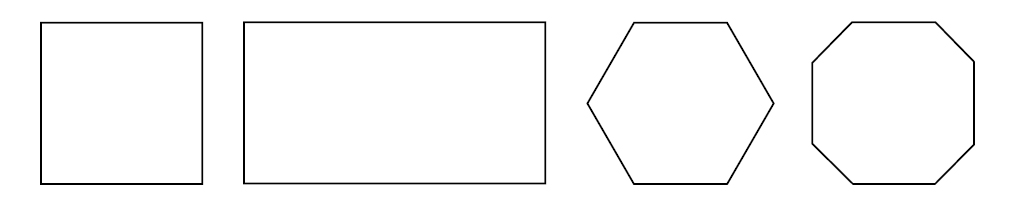
Shape other is used, for example, when an individual piece is completely unique or when multiple shapes, such as rectangles and squares, stand out on the finished surface.
Shelf life in days
Shelf life in days from the date of manufacture. A value of 0 means the product does not expire when properly stored.
Shower head spray modes
The overhead shower offers one or more spray modes, affecting the water flow and shower experience.
- Rain – A steady and soft spray that mimics natural rainfall.
- SmartRain – A water-saving version of Rain, optimized for lower water consumption.
- Jet – A powerful and focused spray, ideal for massage or intensive rinsing.
- Massage – A rotating and rhythmic spray that helps relax muscles.
- ActiveRain – An improved rainfall spray with larger, softer drops for a more luxurious shower experience.
- PureRain – An innovative spray that massages tense muscles or rinses shampoo effectively.
- PowderRain – An ultra-soft and relaxing spray with microfine droplets.
Shut-off valve
The shut-off valve stops the water flow. The given value is the connection size of the shut-off valve.
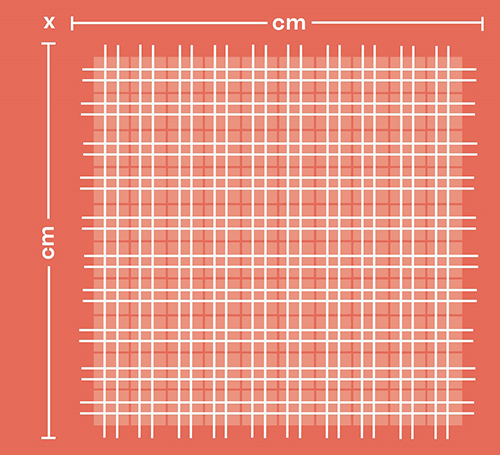
Size of meshed sheet cm
Smaller tiles, under the 10x10 size, may be glued and mosaics are glued by mesh backing to speed up the tiling process. The mesh backing indicates how the tiles are meshed to each other. We provide this information for all tiles under 10x10 cm in the 'Mesh Backing' section. When backed with mesh, the tiles form a sheet, the size of which is shown here.
Slip resistance class A, B, C for foot
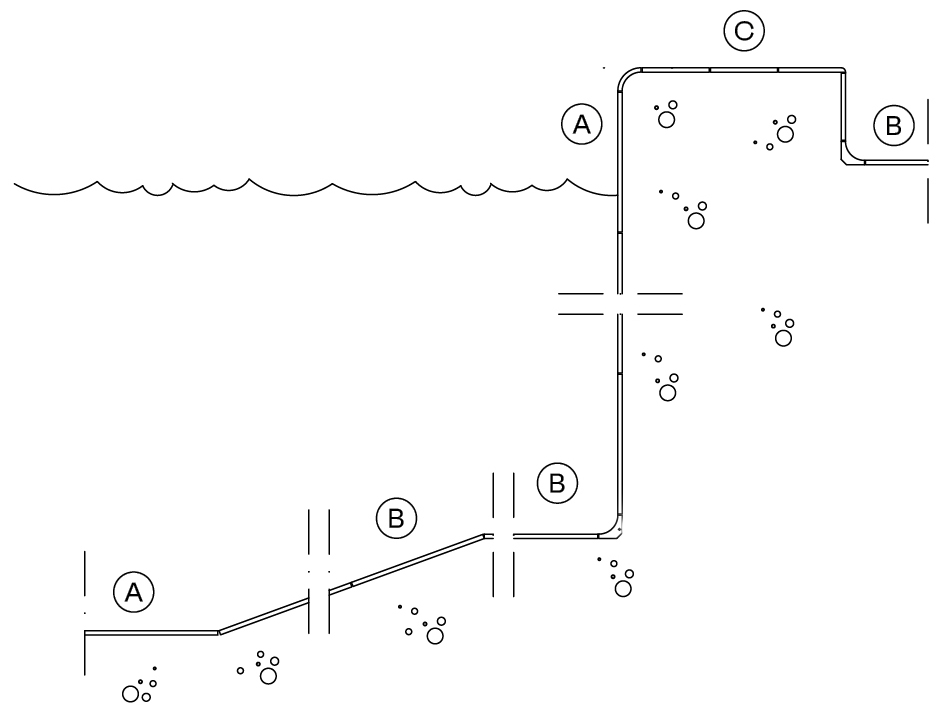
The ABC classification indicates the friction of the tile surface tested according to the DIN 51097 standard. The A/B/C values of the tile are measured by testing with a bare foot on a wet tile surface, which is tilted at a certain angle. As a result of the test, the tile achieves an A, B, or C classification depending on the angle of inclination at which slipping occurs with a bare foot.
The slip resistance classification of floor tiles is determined by the intended use of space. The ABC classification should be considered when selecting tiles for areas where people walk barefoot and where there may be water between the bare foot and the tile. In public spaces, the slip resistance classification of floor tiles is determined by the intended use of the space, while in residential areas, tiles without an ABC classification can be used.
| Value | Examples of public space applications | |
| A |
Dry areas where people walk barefoot, e.g., changing rooms. |
 |
| B |
Wet areas where people walk barefoot, e.g., shower rooms |
 |
| C |
Wet areas where people walk barefoot and require special friction, e.g., steps of swimming pools and inclined ramps. |
 |
Tiling can also be done according to a special plan.
Swimming pools:
| A |
|
| B |
|
| C |
|
Slip resistance class R9-R13 for shoe
The R-rating indicates the friction of the tile or vinyl surface tested according to the DIN 51130 standard. The R-rating of the flooring material is measured with footwear on the wet material, which is tilted at a certain angle. As a result of the test, the material achieves an R9-R13 rating depending on the angle of inclination at which slipping occurs while wearing shoes.
The slip resistance rating of the flooring material is determined by the intended use of the space. The R-rating should be considered when selecting materials for areas where people walk with shoes on, and where water or moisture may occasionally be between the shoe and the floor. The slip resistance class affects the care and maintenance of the flooring material. In the material planning, it should be noted that the rougher the surface, the more difficult it is to clean the floor. Therefore, a rough flooring material may not necessarily be the best option for all spaces. In public spaces, the slip resistance rating of the flooring material is determined by the intended use of the space, whereas in home environments, materials without an R-rating can be used.
| Value | Examples of public space applications | |
| R9 | Offices and standard commercial spaces |  |
| R10 | Food stores |  |
| R11 | Terraces, stairs, and steps in outdoor areas, as well as catering kitchens |  |
| R12 | Industrial spaces and, for example, commercial kitchens |  |
| R13 | Industrial floors that are exposed to substances causing slip hazards (e.g., oil and grease) |  |
Tiling can also be done according to a special plan.
Soft close seat cover
Soft-close function for toilet seats. The function slows down the lowering of the seat and seat ring. The damping prevents loud sounds from the seat being lowered, which can be heard far away, especially in apartment buildings.
Sound absorption alpha s at frequency 1000 Hz (EN ISO 354)
The sound absorption test determines how much sound the material absorbs from the reflected sound waves in the space at a specific frequency. The measurement results are presented as an alpha s value, which ranges from 0.00 (no sound absorption) to 1.00 (absorbs all sound) at that frequency.
Sound absorption alpha s at frequency 125 Hz (EN ISO 354)
The sound absorption test determines how much sound the material absorbs from the reflected sound waves in the space at a specific frequency. The measurement results are presented as an alpha s value, which ranges from 0.00 (no sound absorption) to 1.00 (absorbs all sound) at that frequency.
Sound absorption alpha s at frequency 2000 Hz (EN ISO 354)
The sound absorption test determines how much sound the material absorbs from the reflected sound waves in the space at a specific frequency. The measurement results are presented as an alpha s value, which ranges from 0.00 (no sound absorption) to 1.00 (absorbs all sound) at that frequency.
Sound absorption alpha s at frequency 250 Hz (EN ISO 354)
The sound absorption test determines how much sound the material absorbs from the reflected sound waves in the space at a specific frequency. The measurement results are presented as an alpha s value, which ranges from 0.00 (no sound absorption) to 1.00 (absorbs all sound) at that frequency.
Sound absorption alpha s at frequency 4000 Hz (EN ISO 354)
The sound absorption test determines how much sound the material absorbs from the reflected sound waves in the space at a specific frequency. The measurement results are presented as an alpha s value, which ranges from 0.00 (no sound absorption) to 1.00 (absorbs all sound) at that frequency.
Sound absorption alpha s at frequency 500 Hz (EN ISO 354)
The sound absorption test determines how much sound the material absorbs from the reflected sound waves in the space at a specific frequency. The measurement results are presented as an alpha s value, which ranges from 0.00 (no sound absorption) to 1.00 (absorbs all sound) at that frequency.

Sound absorption value alpha w (EN ISO 11654)
The sound absorption test determines how much a given material absorbs sound waves bouncing around a space at different frequencies. The measurement results obtained for various frequencies are rounded and weighted into a single, unified sound absorption value called alpha w (αw). This creates one number that is easy to compare.The sound absorption value indicates the absorption coefficient of a surface. The absorption coefficient is the ratio between the sound energy that does not reflect back and the total sound energy incident on the surface — in other words, how much sound the surface absorbs. This is expressed as a numerical value ranging from 0.00 (absorbs no sound) to 1.00 (absorbs all sound).
Spacing between fixing bolts mm
The installation distance of the wall-mounted toilet, i.e., the measurement between the mounting bolts. The value is also provided on the wall-mounted WC elements, where it indicates the compatible mounting distances.
Staggering
Staggering indicates how much the material to be installed can be staggered during the installation process to achieve a successful result. Often, the size and shape tolerance of tiles do not allow for large staggers (e.g., only a few tile sizes are suitable for half-tile staggering). For this reason, it is recommended to do a dry layout of the tiles on a flat surface to ensure the suitability of the desired staggering for the project
Examples of different staggers on the long side: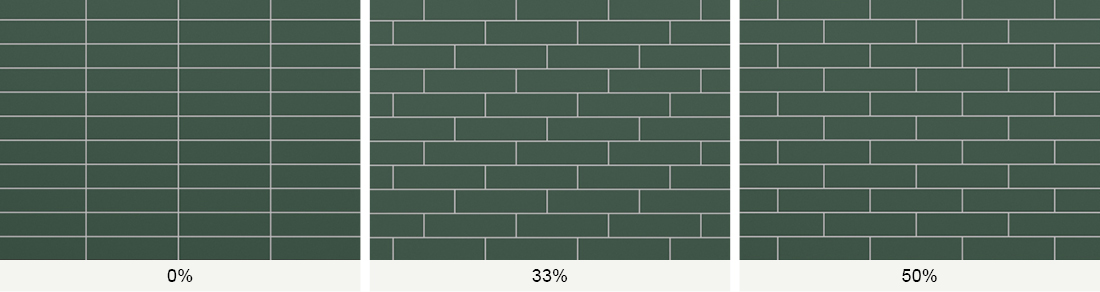
Examples of staggering on the short side: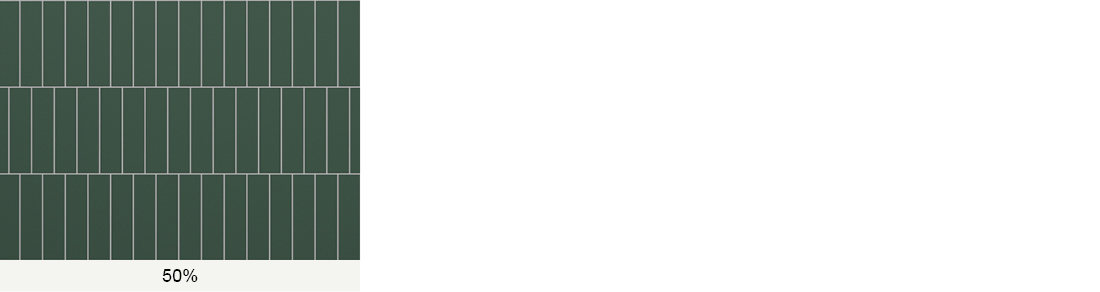
Standard class
The standard class provides information about the composition and properties of the product, as well as the results achieved in the tests included in the standard in question.
Suitable for basin type
It is important to remember that these guidelines regarding faucet selection are indicative, and the final decision on the choice of faucet is always the customer's responsibility.
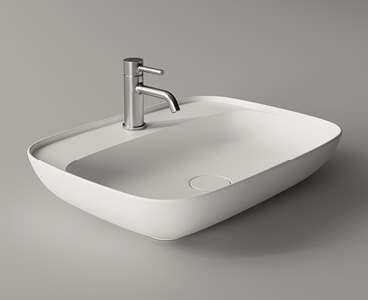
The faucet is best suited for washbasins with a designated faucet hole
When the height of the faucet from the countertop to the aerator is less than 180 mm, it is best suited for traditional washbasins with a faucet installation hole.
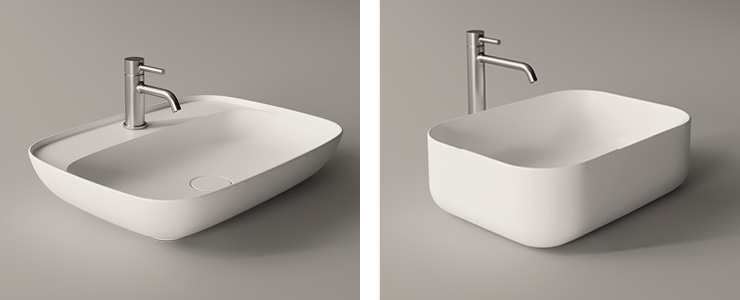
The faucet is best suited for washbasins with a designated faucet hole, but also for low vessel sinks.
When the height of the faucet from the countertop to the aerator is 180–210 mm, it is suitable not only for traditional washbasins but also for low vessel sinks. However, make sure that the position of the lever handle does not cause issues with the edge of the vessel sink.
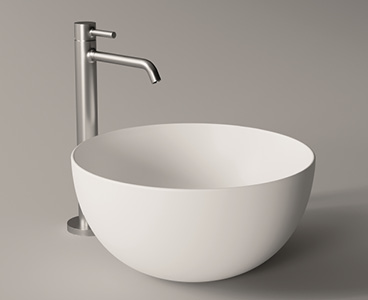
The faucet is also suitable for taller vessel sinks
When the height of the aerator from the countertop is over 210 mm, the faucet is also suitable for taller vessel sinks. However, make sure that the position of the lever handle does not cause issues with the edge of the vessel sink.
Suitable for wet areas
Ceramic tiles are generally suitable for wet areas.
A wet area is considered to be a space that is exposed to direct water or where water flows along wall and floor surfaces, such as the shower area. Acidic or alkaline cleaning agents are used to clean these areas to keep the surface of the ceramic tile free from lime, detergent, and grease residues.
A ceramic tile that cannot be cleaned with conventional cleaning agents and methods for removing lime and grease is not suitable for wet areas. Tiles that, due to their manufacturing method, should not get wet are also not suitable for wet areas. Such products include specially glazed tiles and paper mounted mosaic tiles.
Surface material / Surface treatment
Surface material refers to the treatment or material of the visible surface of a product, especially when it differs from the material of the product’s core structure.
| Anodized Aluminum | An oxidized aluminum surface that is hard, durable, and corrosion-resistant. |
| Antibacterial elastomer blend | Antibacterial elastomer blend is a polymer with rubber-like elasticity and flexibility. It deforms when stretched or compressed and returns to its original shape once the force is removed.Due to its antibacterial treatment, the surface prevents the growth and multiplication of bacteria and significantly reduces their presence - almost entirely. |
| Cromall | A corrosion-resistant metal alloy, finished with a chrome coating. |
| Chrome | A shiny and durable surface treatment that is easy to keep clean. |
| Plastic | A lightweight, affordable, and easy-to-maintain material. |
| Powder epoxy painted | Powder epoxy painted refers to a surface coated with powder-form epoxy and heat-cured. The epoxy coating is durable and provides a smooth finish that protects against moisture and wear, making it suitable for surfaces exposed to heavy use. |
| Powder epoxy painted/integral plastic | Powder epoxy painted refers to a surface coated with powder-form epoxy and heat-cured. The epoxy coating is durable and provides a smooth finish that protects against moisture and wear, making it suitable for surfaces exposed to heavy use. Integral foam is particularly well-suited for high-wear surfaces, including cleanroom environments. |
| Powder painted | A durable and smooth painted surface that protects against moisture and wear. |
| PVD (Physical Vapor Deposition) | An extremely durable and scratch-resistant coating. Maintains its appearance even under heavy use. |
| Stainless steel | A durable and hygienic metal surface that does not rust in humid conditions. |
Surface pretreatment
Depending on the tile's surface finish, the micro-pores on the tile's surface may be open. In such cases, the tiles should be protected before grouting or before the tiled area is put into use.
In the pre-treatment process, the micro-pores on the surface are saturated to prevent dirt from being absorbed and to facilitate cleaning of the tile surface. It is recommended to perform the pre-treatment before grouting to prevent the color pigments in the grout from being absorbed into the pores.
Surface shape
The surface texture of a tile describes how the tile looks and feels when touched by hand. Below are descriptions of different types of tile surface textures:
| Value | Description of value | |
| Flat, smoothed surface | The tile surface is flat and feels smooth, and it is smoother from technical properties than a flat surface tile. |  |
| Flat surface | The tile surface is smooth and feels smooth to the touch. |  |
| Flat anti-slip surface | The tile has a smooth appearance, but it's rough for the technical characteristics, and it feels more rougher than a flat-surfaced tile. |  |
| Roughned | The tile surface is rough. The roughness is created by adding rough elements to the tile surface. The surface roughness is evenly symmetrical. |  |
| Hammered | The tile surface is rough. The roughness is created mechanically by hammering the tile surface. The surface roughness is asymmetrical, as the hammering creating unique indentations and hammer marks on the tile. |  |
| Structured | The tile surface features asymmetrical and three-dimensional shapes. | 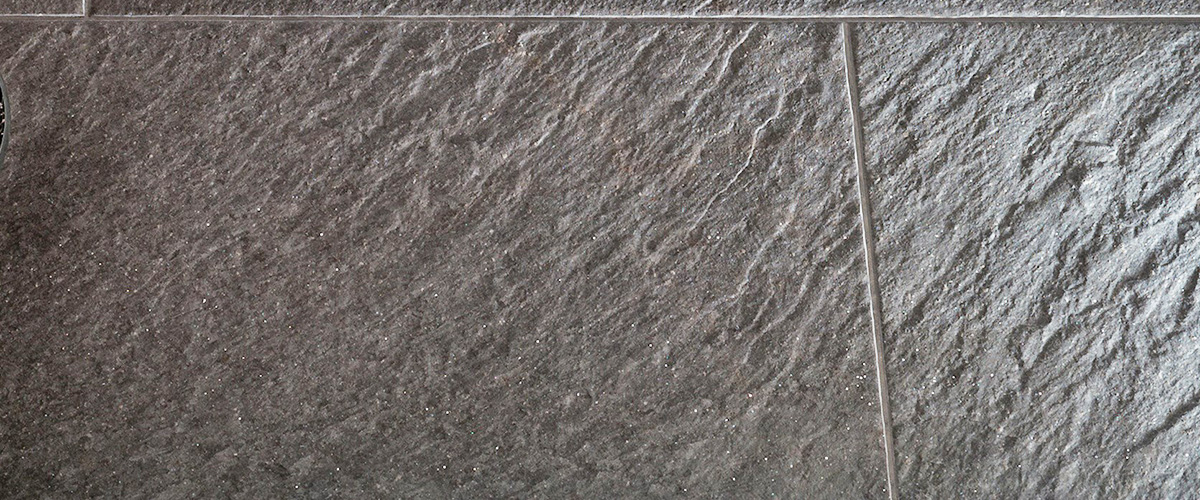 |
| Wavy | The tile surface has asymmetrical and three-dimensional shapes, and it feels slightly wavy to the touch. | 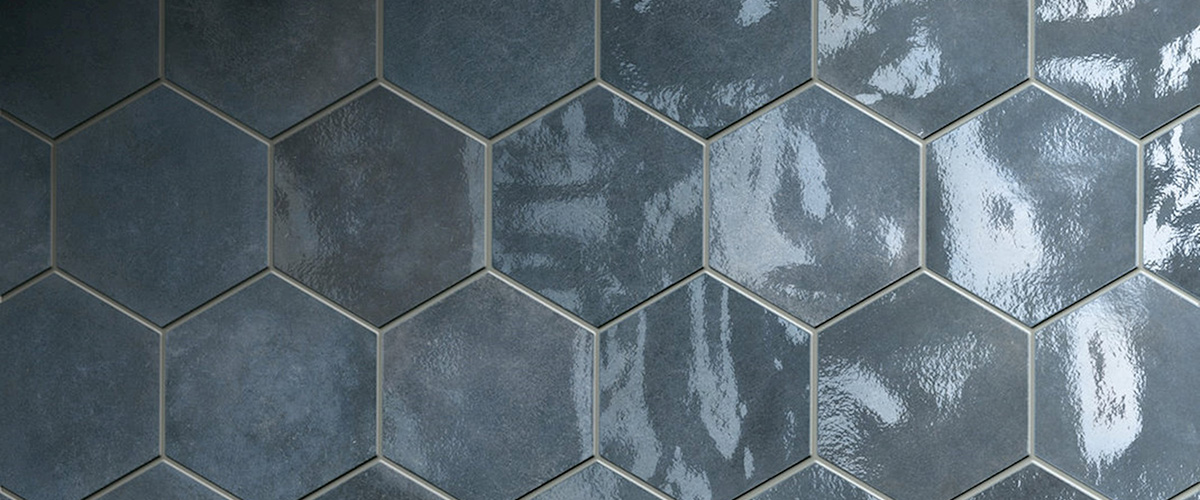 |
| Rustic | The tile surface features asymmetrical and three-dimensional shapes. The tiles have uneven edges. The appearance of the tile aims to old-fashioned and a rustic atmosphere. | 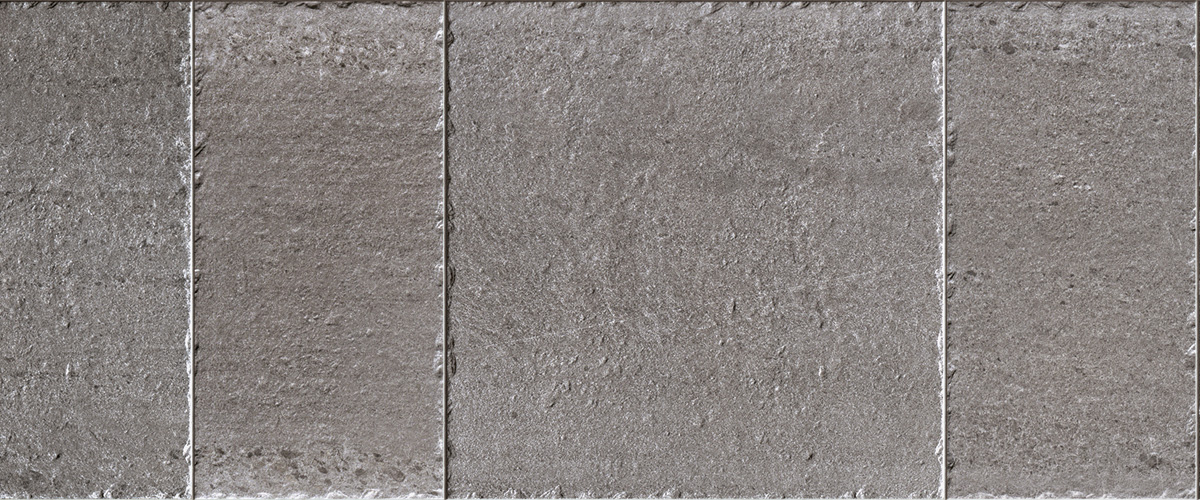 |
| Fluted | The tile surface has pronounced parallel striped shapes, creating an overall striped appearance. |  |
| Grooved stair tile | The tile surface features symmetrical, parallel milled grooves designed to serve, for example, as an anti-slip feature. | 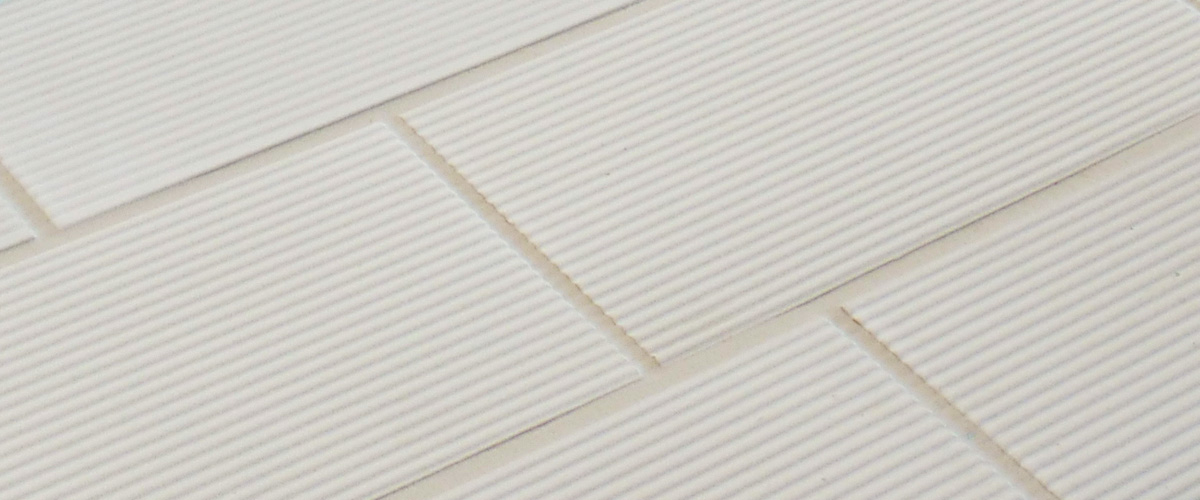 |
| Embossed | The tile surface has pronounced symmetrical or textured shapes, such as patterns or anti-slip patterns. | 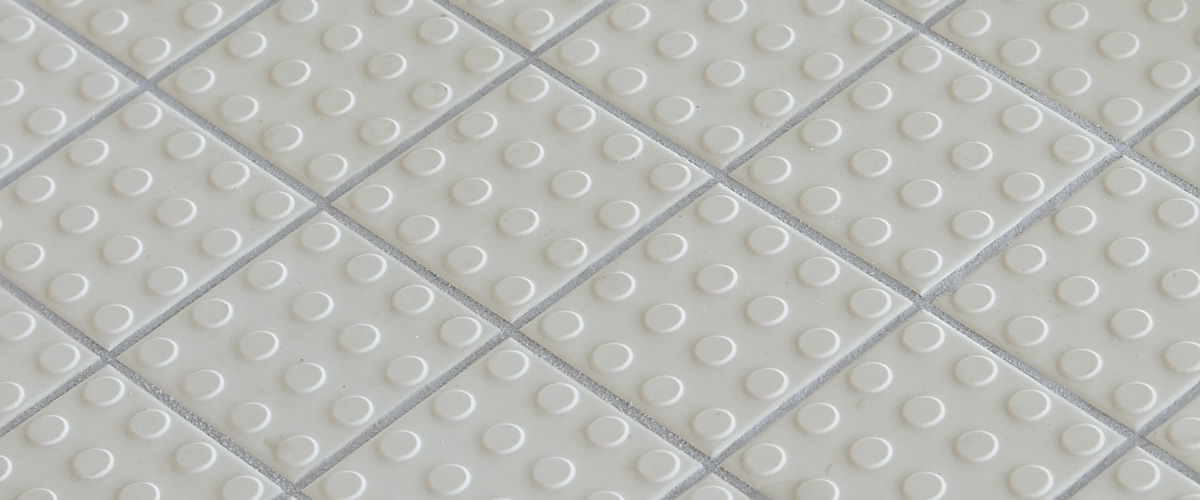 |
| Faceted | Laatan sivut ovat viistetty niin, että laatta on paksumpi keskeltä kuin reunoilta. | 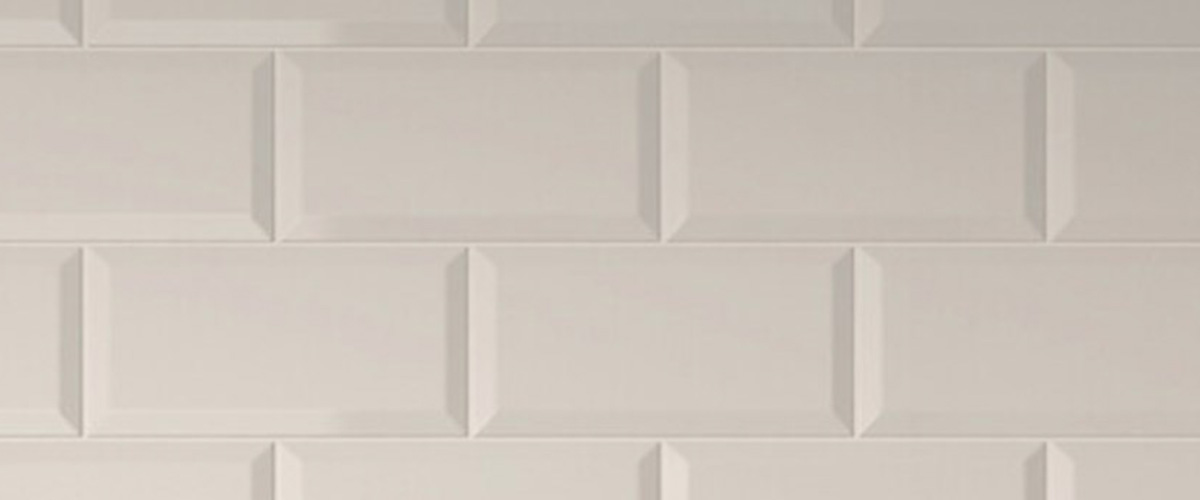 |
The surface finish of the support handle. Texture defines whether the surface is, for example, smooth, rough or patterned.
Surface treatment
Laufen products are available with the Laufen Clean Coat (LCC) surface. LCC is a ceramic glaze developed by Laufen that is easier to keep clean and more hygienic. The LCC surface is durable and exceptionally smooth, which prevents dirt from adhering and facilitates cleaning. This also reduces the need for strong cleaning agents and the environmental impact.
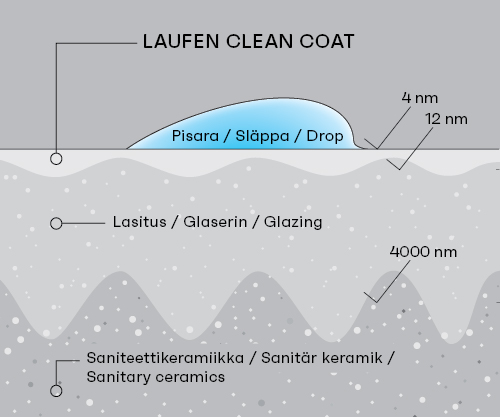
Swiveling spout
The product features a swivel spout that rotates a specified number of degrees. In some models, the swivel range can be limited, for example to 90 or 120 degrees. If no restriction is in place, the spout can rotate freely 360 degrees.
Please note that in spaces without a floor drain, the spout must not be turned beyond the edge of the basin.
Tank
The type of WC seat or cistern element.
Porcelain cistern
The water is in the porcelain cistern without a separate tank inside.
Plastic cistern
The water is in a plastic cistern.
Insulated plastic cistern
The water is in an insulated plastic cistern.
Tap hole
Information if product includes tap holes and where they are located. A tap hole is the place where the tap is fixed.
Tap installation type
Fixture-specific installation methods may include the following:
Countertop – The fixture is attached to the washbasin, countertop, or the edge of the bathtub.
Wall mounted – The fixture or shower is installed on the wall surface or partially within the wall structure.
Wall mounted, not suitable for installation on surface pipes – Installation of the fixture or shower requires concealed plumbing.
On the ceiling – The shower is suspended from or attached to the ceiling.
Recessed in the ceiling – The shower or part of it is embedded into the ceiling.
On the floor – The fixture is installed into the floor with a recessed body, common for freestanding bathtub faucets.
Thickness of wear layer mm
A transparent layer on the surface of LVT that has a decisive impact on wear resistance.
Tile manufacturing size cm
Ceramic tile is made from various clays, quartz, and feldspar by firing at high temperature, causing the tile to shrink and densify (sinter) significantly. For this reason, the dimensions of the products are not entirely absolute. The dimensions of the tiles are determined according to the ceramic standard SFS-EN 14411 EN ISO 10545-2. For tiles, both nominal dimensions, from which ("the nominal size") is derived, and manufacturing dimensions, from which ("the work size") is derived, are determined.
Example 1: If the nominal size of a tile is 60x60 cm, its work size can vary by +/-5 mm from the nominal dimension, i.e., for example, 597x597 mm.
Example 2: If the size of the tile is 10x10 cm, the work size of an individual tile on a mesh sheet can be, for example, 97x97 mm..
The work size of the tiles should be confirmed before permanently installation them to substrate. The same nominal size of tiles from two different manufacturers does not mean that the work sizes of the tiles from both manufacturers are the same. Even if the size is identical, it cannot be assumed that the joint width will be the same when tiles are combined in the same or adjacent areas. The manufacturing method and dimensional accuracy of the tile also affect the size classification according to the standard.
Tile type
| Value | description of value | |
| Tile | The tile type indicates all tiles suitable for basic tiling. |  |
| Pattern tile | Patterned tiles refer to tiles with bold patterns used as accents or visual elements in tiling projects or interior designs. | 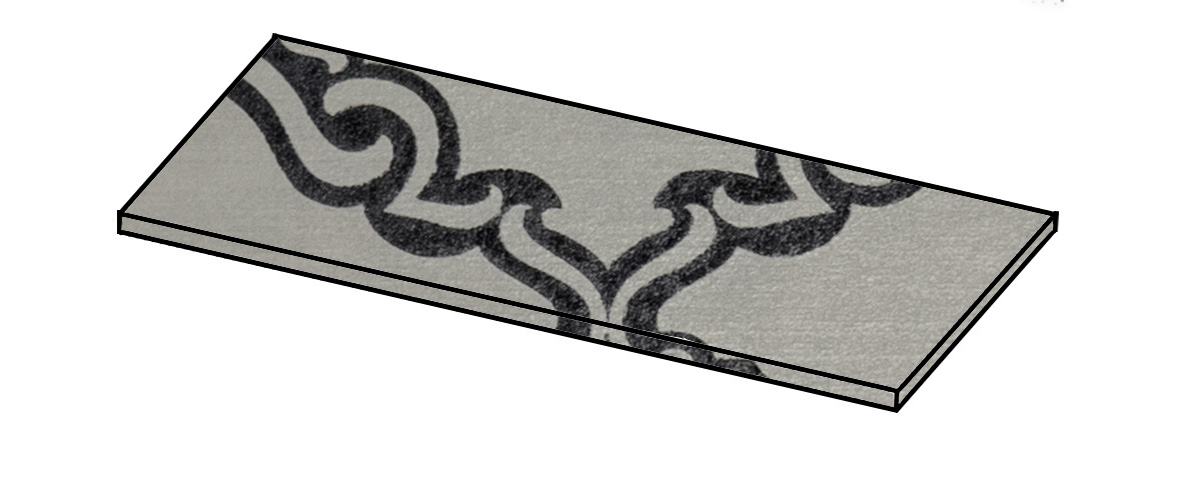 |
| Mosaic | Tiles smaller than 7 x 7 cm are called mosaics. They can be various types of ceramic tiles or tiles used similarly to ceramic tiles, such as glass mosaics. The characteristics of mosaics include fracture angles, streaks, indentations, bubbles, etc., which contribute to their unique appearance. |  |
| Border, border inside corner, border outside corner | Borders are narrow decorative elements that are tiled along with the basic tiling to create a ribbon-like or stripe-like visual effect. Borders can be used to delineate or divide the tiling into different areas or to finish the edges of the tiling Inside and outside corner pieces for borders allow for neatly finished tiling of borders, especially at the corners where walls meet. |
|
| Skirting tile, skirting tile inner corner, skirting tile outer corner | Jalkalista on valmiiksi käyttötarkoitustaan varten muotoiltu, esimerkiksi yläreunastaan pyöristetty, valmis kappale, jota voidaan käyttää lattian ja seinän rajassa seinälle nostettuna. A skirting is a pre-shaped piece for its intended purpose, for example, with a rounded top edge, that can be used at the junction of the floor and wall. The skirting is installed in the same way as the other tiles. |
|
| Step tile | A step tile is a pre-shaped piece designed for its intended purpose, for example, with a rounded front edge or shaped to fit a stair step, that can be used as a surface material for stair steps. The step tile is installed in the same way as the other tiles. | 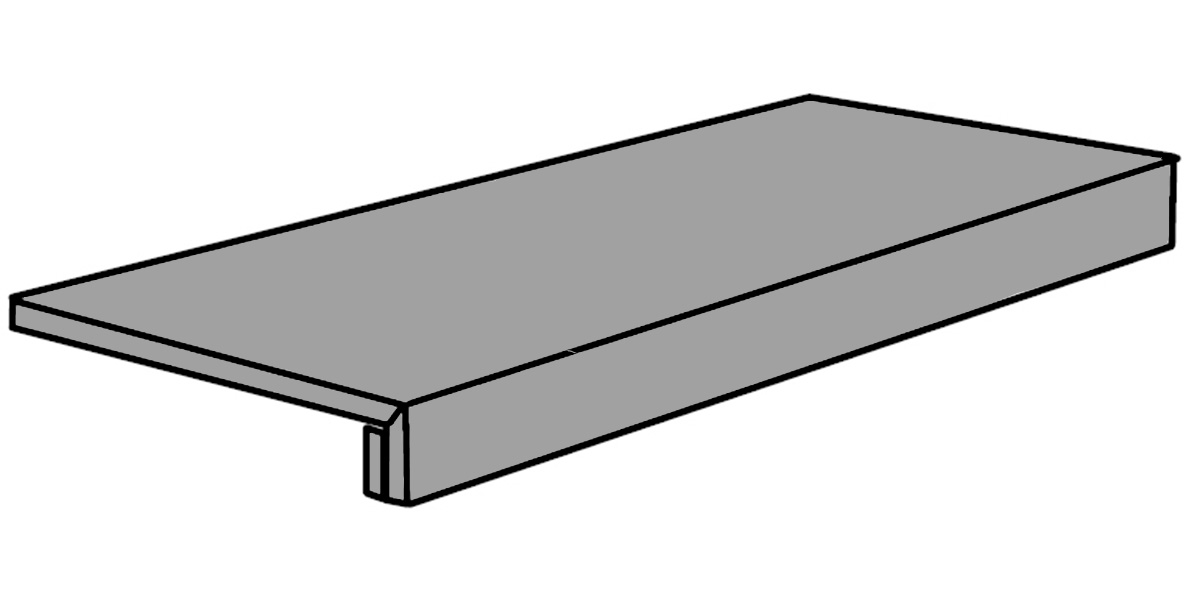 |
The firing batch and manufacturing method of patterned tiles, borders, skirtings, and step tile pieces may differ from those of the basic tile. A color shade difference compared to the basic tile is also possible and completely normal in ceramics.
Timer function
Timer functions vary depending on the product, but the most common feature is the ability to set how long the product stays on.
Toilet installation
Toilet seat installation refers to the method used to attach the toilet seat.
Wall-hung toilets are usually mounted either from the sides with visible fixings or with concealed installation from the top or bottom. Side installation is quicker to carry out, but concealed installation provides a cleaner finish as the fixings remain hidden.
Floor-mounted toilets are installed to the floor using adhesive
Toilet space requirements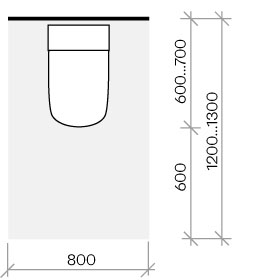
- 600 mm in front of the toilet seat, approximately 200 mm on the sides
- A free wall surface is required near the toilet seat for mounting the toilet paper holder and any possible support bars.
- The toilet room is equipped with a hand shower, and accessibility from the toilet seat is taken into account. A maintenance space of 400 mm must be provided above the tank of the floor-mounted toilet.
Toilet seat cover installation method
Toilet seat covers are divided according to the installation method into top-mounted and bottom-mounted covers.
Bottom installation
Covers mounted from the bottom require space below the installation hole for the nuts to be mounted. This limits the design of the toilet seats, and the fasteners are often visible on the outside of the toilet seat.
Top installation
Covers mounted from the top fit almost all toilet seats, as the installation is done from above the seat. Top-mounted covers have various fastening mechanisms, but the common method is to insert a bolt with a washer and nut through the mounting hole, after which the nut is tightened against the inner surface of the porcelain using the washer.
Tolerance
Tolerance defines the allowed limits for the product's technical characteristics, in this case, the product's dimensional tolerance. Ceramics, such as ceramic tiles and ceramic washbasins, may be slightly different in size from the specified dimensions due to the manufacturing process. The dimensional variation is a result of the shrinkage of ceramics during the firing process.
The dimensional tolerance of ceramic tiles varies depending on the manufacturing method, and the tolerance is the acceptable dimensional variation according to the standard of the specific manufacturing method.
Compliance with the tolerance is demonstrated using the measurement technique according to the standard. Refer to the specific tile measurement instructions here.
Towel rail medium
The medium of a towel rail is the substance used inside the towel rail.
In some electric towel rails, the medium is air, and in this case, the heating is done by a heating wire inside the towel rail. In other towel rails, the medium is water or another liquid. The liquid refers to the medium in electric towel rails, which is usually a mixture of water and glycol.
Trash can type
The type of trash can is often chosen based on its purpose or space.
Type approval
In 2020, the Ministry of the Environment's decree 497/2019 came into force. The decree sets the essential technical requirements for water fixtures. Products in accordance with the water fixture regulation must be used in all renovation and new construction projects where the building permit was granted on or after January 1, 2020. In Finland, type approval, or a type approval decision, can be used to demonstrate that a water fixture complies with the regulation. If the product does not have Finnish type approval, its suitability for the specific application must be verified separately.
The product has Finnish type approval. The product has been granted type approval. It has passed the required tests and meets the requirements of the water fixture regulation.
 |
In Finland, type-approved products can be recognized by this mark. | |||
The product does not have Finnish type approval, but it has an STA product certificate and meets the requirements of the water fixture regulation. Please ensure the product's suitability for the specific application. The product is not type-approved in Finland, but it has a Swedish STA product certificate, which demonstrates that it meets the requirements of the water fixture regulation. However, it is recommended to verify that the product is suitable for use in the specific application.
The product does not have Finnish type approval. Please verify the product's suitability first. The product is suitable for applications that are not subject to building permits. A type approval decision has not been sought for the product.
The product type does not require national type approval. The Water Fittings Regulation only applies to taps intended for water withdrawal. If the product is not a tap, it is not subject to the regulation.
Type of bathtub
The type of bathtub indicates whether it is a regular bathtub or a whirlpool bath.
Type of drainage
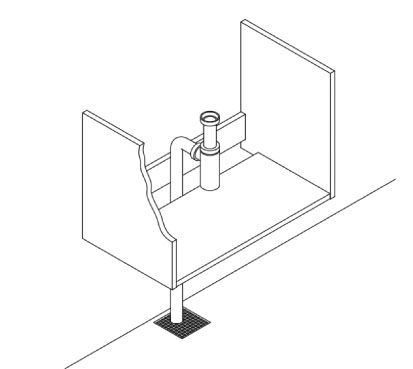
In vanity units, the bottom panel is shortened to accommodate drain pipes.
Type of heating
Towel warmers are available with several different heating types. When choosing a product, make sure it is suitable for the location.
Electricity
Electrically heated towel warmers are roughly divided into two groups depending on the medium used for heating. When the medium is air, towel warmers are usually small and have a fixed, constant temperature that cannot be adjusted. When the medium is water or another liquid, towel warmers are more efficient and the temperature can be adjusted using the towel warmer's thermostat.
Heating water
Towel warmers connected to heating water are heated via the house's heating network. The maximum temperature of the towel warmer depends on the temperature of the water circulating in the network. The temperature varies depending on the season. However, the temperature can be lowered if a separate thermostat is installed in the product.
Domestic hot water
Towel warmers connected to domestic water are heated via the house's domestic water circulation network. The maximum temperature of the towel warmer depends on the temperature of the water circulating in the network. However, the temperature can be reduced if a separate valve is installed in the product to limit the flow. However, the water circulation of a towel warmer connected to the domestic water supply cannot be completely closed. Towel warmers installed in the domestic water supply have special requirements, for example, regarding the material.
Hybrid
Hybrid model towel warmers combine water-circulated and electric heating. It is possible to install an electric heater as an additional accessory in a towel warmer connected to the heating water supply. The advantage of a hybrid towel warmer is the possibility of heating the towel warmer with electricity in the summer, when the heating of the house is otherwise reduced.
Type of seat
Toilet seat type. Toilet seats are divided into five groups according to their features.
Wall-hung toilet
Wall-mounted toilet seats with a distance from the wall of more than 50 cm.
Wall-hung toilet short
Wall-mounted toilet seats with a distance from the wall of up to 50 cm.
Floorstanding toilet
Floor-mounted toilet seats with a seat height of up to 43 cm.
Floorstanding toilet high
Floor-mounted toilet seats with a seat height of more than 43 cm.
Wall-hung shower toilet
Wall-mounted toilet seats equipped with washing functions.
Use on stairs
If a textile carpet is used on stairs, the parts of the carpet, especially the edges of the stairs, are subject to significant wear and tear. Special test conditions can be used to determine whether the covering can be used continuously or only occasionally on stairs that are exposed to wear and tear.
Continuous use (public space, e.g. hotel)
Occasional use (home)
Volume / capacity in liters
The amount of water the bathtub can hold in liters.
Washbasin installation
Different possible installation methods for the washbasin. The same washbasin may have several installation options.
Space requirements for the washbasin.
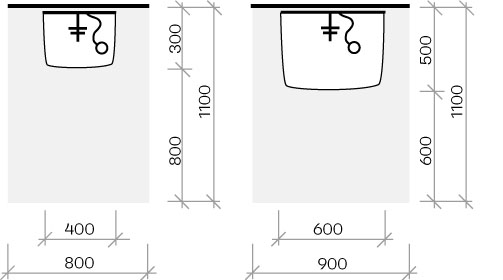
-
Space required for use: 800–900 x 1,100 mm.
Free space is needed above and around the sides of the washbasin. Typically, countertop and storage space, a mirror, and an electrical outlet for appliances are required near the sink.
When designing furniture for tight spaces, the dimensional tolerance of porcelain sinks must be taken into account.
Washbasin installation dimensions
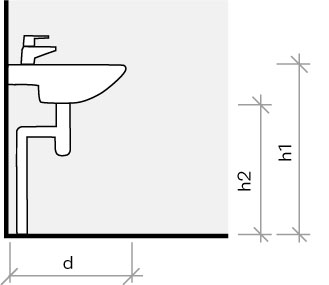
h1 washbasin height from the floor:
800...900 mm for adults
600...700 mm* for preschool children
700...900 mm for elderly, mobility-impaired individuals
h2 minimum required leg clearance:
200...400 mm for small sinks
400...600 mm for large sinks
580...630 mm for wheelchair users
A step stool can be used for children to reach the washbasin.
Washing machine valve
A washing machine valve required for the water supply to the washing machine can be connected to a washbasin tap or a kitchen tap. A washing machine valve is a valve that can be used to open or stop the water flow to the washing machine. The washing machine valve can operate mechanically or electronically.
Wastage from installation percentage
During the installation of ceramic tiles, textile tiles, wall-to-wall carpets, and vinyl flooring, product "working allowance" is always generated. Therefore, when purchasing the product, a sufficient amount of extra material should be reserved, and this should be accounted for in the quantity calculation. The extra material required is typically calculated as a percentage of the area to be installed. The amount of additional material depends on the following factors:
Size of the product to be installed
Layout and installation directions of the products
Pattern of the products
Shape of the space
Openings in the space, such as windows and doors
|
Installed material |
Typical extra material need % |
| Ceramic tile | 5-15 |
| Textile tile | 1-5 |
| Wall-to-wall-carpet | 10-15 |
| Vinyl (LVT) | 5 |
Since product production batches are rarely mixable with each other, it is recommended to always reserve a little extra material for potential breakage during installation or use to ensure a uniform result.
The buyer is always responsible for the quantity calculation.
Water absorption capacity (EN 13888)
The EN 13888 classification W for tile grouts means that the product has reduced water absorption in its class. Water absorption is below the test limits of 2 g (30 min) and 5 g (240 min).
Wear resistance (EN 1307)
Textile floors, as well as woven vinyl floors, are classified into usage classes based on their abrasion resistance (EN 1307).
Home flooring: usage classes 21–23
21: Light traffic, e.g., bedroom
22: Normal traffic, e.g., living room, hallway
22+: From normal to heavy traffic, e.g., living room, hallway, dining room, corridor
23: Heavy traffic, e.g., living room, hallway, dining room, corridor

Public flooring: usage classes 31–34
31: Light traffic, e.g., hotel room, small office
32: Normal traffic, e.g., classroom, small office, small shop
33: Heavy traffic, e.g., office, corridor, department store, school
34: Very heavy traffic, e.g., airport, shopping mall

Light industrial: usage classes 41–43
41: Light traffic – electronics and precision mechanics assembly areas
42: Normal traffic – storage areas, electronics assembly areas
43: Heavy traffic – storage areas, production halls

Wear resistance (EN 685)
LVT floors are classified into usage classes based on their abrasion resistance (EN 685).
Home flooring: usage classes 21–23
21: Light use, e.g. bedroom
22: Normal use, e.g. living room, hallway
22+: From normal to heavy use, e.g. living room, hallway, dining room, corridor
23: Heavy use, e.g. living room, hallway, dining room, corridor

Public flooring: usage classes 31–34
31: Light use, e.g. hotel room, small office
32: Normal use, e.g. classroom, small office, small store
33: Heavy use, e.g. office, corridor, department store, school
34: Very heavy use, e.g. airport, shopping mall

Light industrial: usage classes 41–43
41: Light use – electronics and precision mechanics assembly areas
42: Normal use – storage areas, electronics assembly areas
43: Heavy use – storage areas, production halls

Wear resistance (EN ISO 10874)
LVT floors are classified into usage classes based on their abrasion resistance (EN ISO 10874).
Residential floors: usage classes 21–23
21: Light abrasion, e.g., bedroom
22: Normal abrasion, e.g., living room, hallway
22+: From normal to heavy abrasion, e.g., living room, hallway, dining room, corridor
23: Heavy abrasion, e.g., living room, hallway, dining room, corridor

Public floors: usage classes 31–34
31: Light abrasion, e.g., hotel room, small office
32: Normal abrasion, e.g., classroom, small office, small shop
33: Heavy abrasion, e.g., office, corridor, department store, school
34: Very heavy abrasion, e.g., airport, shopping center

Light industry: usage classes 41–43
41: Light abrasion – electronics and micromechanics assembly areas
42: Normal abrasion – storage areas, electronics assembly areas
43: Heavy abrasion – storage areas, production halls

Wet room/Dry room
There are no restrictions on using the products in dry indoor spaces. However, not all products are suitable for use in wet rooms or other similar spaces where moisture exposure is higher than normal.
Waterproofing is an essential part of the structures of wet rooms and it is important to consider which products are suitable for wet rooms below the waterproofing and which products can be used in wet rooms above the waterproofing.
Whirlpool system
Whirlpool system
There are various jet systems available in hot tubs, consisting of either air massage, water massage or a combination of both.
Air massage
Hot tubs equipped with an air massage system have high-quality 500 W air compressors that blow air through nozzles at the bottom of the tub.
Water massage
Hot tubs equipped with water massage have at least one powerful 1500 W water pump, which provides power for various massage features, depending on the hot tub system. The power of the water massage is infinitely adjustable regardless of the model. Hot tubs equipped with the Luxury Dual system also have a second 1100 W water pump, which has a separate start switch.
Air massage and water massage
Hot tubs equipped with the Comfort 2, Luxury and Luxury Dual systems include air and water massage. Massage features vary depending on the system.
Working temperature °C
The recommended temperature for installation and drying specified for the product.
Temperature affects the performance of many products and the drying and hardening reaction. Cooler temperatures generally slow down reactions, while warmer temperatures accelerate them. In addition to the conditions, the temperature of the products themselves when they are used must also be taken into account. For example, many dry products can be stored in a cool place, but the products should be brought to a warm place well in advance of their use.